Key takeaways
- Compare the best storage wardrobes portable for bedrooms and rentals, with fabric-covered and folding cube designs, clear specs, and simple setup advice.
As an Amazon Associate we earn from qualifying purchases.
A bedroom without a built-in closet, a rental where drilling into walls is off the table, a guest room that doubles as overflow storage — these are the situations a portable storage wardrobe is built for. Instead of a permanent fitted unit, you get a freestanding frame with hanging rods, shelves, and usually a cover, and it goes up with hand assembly rather than tools and wall fixings. When you move, it comes apart and moves with you.

The two designs in this guide cover the main approaches to the category. One is the classic fabric-covered frame wardrobe, with steel tubes, plastic connectors, and a non-woven cover that keeps dust off hanging clothes. The other is a folding plastic cube wardrobe, which opens out into a bank of closed cubes with doors, plus hanging sections. Both are genuine portable wardrobes sold as complete units, and both store a full mix of hanging and folded clothing. The sections below explain how to choose between the two styles, then look at each product in detail, with dimensions, materials, and load limits taken from the product pages.
Disclosure: This article contains affiliate links. If you buy through these links, we may earn a commission at no additional cost to you.
How to Choose a Portable Storage Wardrobe
Start with the footprint and the hanging height
Measure the wall run and floor depth you can give up before anything else. Portable wardrobes in this class are typically between about 40 and 67 inches wide and 16 to 20 inches deep, and most stand between 63 and 70 inches tall. Depth matters more than people expect: a standard hanger needs roughly 16 to 18 inches of clear depth once a cover or door is closed, so a shallow unit can leave coat sleeves pressed against the fabric. Hanging height matters just as much. A hanging section around 46 inches clear suits shirts, jackets, and folded-over trousers, while dresses and long coats need a taller uninterrupted drop, so check whether one section of the wardrobe is left free of shelves from top to bottom.
Match the layout to how you actually store clothes
A portable wardrobe earns its floor space only if its internal layout matches your mix of clothing. Count your hanging clothes against the number of rods: one rod fills quickly, two rods let you split everyday wear from seasonal pieces, and three rods suit a full wardrobe with no built-in closet at all. Shelves handle folded knitwear, jeans, bedding, and storage boxes, and side pockets — where fitted — are the right size for belts, gloves, hats, and small accessories that otherwise end up in a drawer. Closed cubes with doors suit a room where the wardrobe is on show, because everything sits behind a panel rather than behind a fabric cover.
Frame material and load limits
Fabric-covered wardrobes use steel or iron tube frames joined by plastic connectors, and the tube diameter is a useful strength signal: tubes around 16 mm are common in this class, and thicker tubes generally flex less under a full rod of coats. Folding cube wardrobes use a plastic panel-and-frame structure instead, which trades the open internal space of a fabric wardrobe for rigid, separate compartments. Whichever style you choose, read the stated load limits per rod and per shelf rather than any single headline figure. A rod limit in the region of 28 to 33 pounds covers a dense row of winter clothing; shelf limits vary widely, from a few pounds on light fabric tiers to much more on rigid cube floors, so load folded stacks accordingly and keep the heaviest items low.
Cover, doors, and dust protection
An open garment rack stores clothes, but it does not protect them. A non-woven fabric cover keeps dust and light off hanging clothes and usually closes with ties or a zip, which suits spare-room and seasonal storage. Transparent or translucent doors on a cube wardrobe do the same job while letting you see what is in each compartment without opening it, and magnetic catches keep the doors shut. If the wardrobe will stand in a living area rather than a bedroom, closed doors also give a tidier, more furniture-like front than a fabric cover.
Assembly and moving
Portability is the point of the category, so assembly should be reversible. Tube-and-connector frames slot together by hand and come apart the same way, which makes them straightforward to flat-pack for a house move. Folding cube wardrobes go further: the frame unfolds into shape in minutes with no tools and no separate fixings, and folds flat again for storage or transport. Check the assembled weight as well. A light fabric wardrobe can be shifted for cleaning by one person, while a large cube unit is considerably heavier once built and is better positioned once and left in place.
Stability and placement
Freestanding wardrobes are tall and relatively narrow, so placement matters. Stand the unit on a level floor, push it flush to the wall, and use any anti-tip kit supplied with it. Load heavy items on the lowest shelves, avoid hanging the full weight of the wardrobe on one end of a single rod, and keep the unit out of walkways where a shoulder or a vacuum cleaner can catch a corner. In a child’s room, wall attachment is not optional — treat it as part of the assembly.
The Products
1. LOKEME Portable Closet — fabric-covered frame wardrobe with three hanging rods
The LOKEME Portable Closet is the traditional portable wardrobe format done at a useful scale: a steel tube frame with a non-woven fabric cover, three hanging rods, six storage shelves, and four side pockets, in black. It measures 52 x 17.9 x 66.9 inches, so it covers a little over four feet of wall while standing about five and a half feet tall, and at 9 pounds it is light enough to reposition without help once it is empty.
The frame uses 16 mm diameter steel pipe with plastic connectors, and the stated load limits are 30 pounds per hanging rod and 14 pounds per shelf, which is a sensible match for the layout: three rods split the hanging load, so a full everyday wardrobe of shirts, jackets, and trousers can be spread across sections instead of concentrated on one rail. The six shelves sit alongside and below the hanging space for folded clothes, bedding, and boxes, and the four side pockets take the small items — hats, gloves, belts, handbags — that otherwise clutter the shelves.
The non-woven fabric cover is the detail that separates this from an open clothes rack. It closes over the front of the unit, keeping dust off stored clothing, which makes the wardrobe a reasonable home for seasonal pieces and guest-room overflow as well as daily wear. Assembly is a slot-together build with an instruction sheet included, and the whole unit breaks down the same way for a move. Care is simple: the product page specifies wiping with a dry cloth.
Choose this design if you want maximum open hanging space in a fabric-covered unit and your priority is a light, movable wardrobe for a bedroom, dorm room, or rental. Its model number is PWC0005-black.
- View on Amazon: https://www.amazon.com/dp/B0C88WNZDY
2. ANTBOX Portable Wardrobe Closet — folding cube wardrobe with doors and two hanging rods
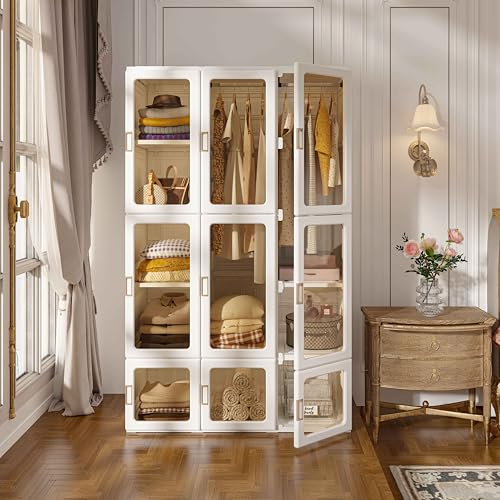
The ANTBOX Portable Wardrobe Closet takes the opposite approach to the same problem. Instead of an open frame behind a fabric cover, it is a folding plastic structure that opens out into eight cubes plus two hanging sections, each cube closed by a transparent door with a magnetic catch. It measures 19.7 x 40.2 x 67 inches — deeper and narrower than the LOKEME, and about the same height — and the doors give it a finished, furniture-like front that suits a living room or a bedroom where the wardrobe is always on view.
The construction is plastic, a polypropylene and ABS mix on the product page, with a thickened folding framework. The standout feature is the assembly: the unit folds open and is ready in about three minutes with no tools, and folds flat again when it is not needed, which is a genuine advantage for temporary living arrangements, spare rooms that change roles, and anyone who has wrestled a tube-and-connector frame apart. At 55 pounds it is a much heavier piece than a fabric wardrobe, so it is best treated as position-once furniture rather than something to move weekly.
Inside, the eight cubes handle folded clothes, shoes, bags, books, and boxed items as separate, closed compartments, and the two hanging rods take shirts, jackets, and coats, including bulky winter pieces, helped by the near-20-inch depth. Because each cube is enclosed, stored items stay dust-free without a separate cover, and the transparent doors mean the contents of each compartment are visible at a glance. The set name on the product page is the 8 Cubes & 2 Hanging Rod Set, and the model number is WT15-D9-H2.
Choose this design if you prefer closed, separated storage with doors over open hanging space, or if fast, tool-free setup and flat folding matter more than raw hanging capacity.
- View on Amazon: https://www.amazon.com/dp/B0CFTNDK5L
Comparison Table
| Feature | LOKEME Portable Closet | ANTBOX Portable Wardrobe Closet |
|---|---|---|
| Format | Fabric-covered frame wardrobe | Folding cube wardrobe with doors |
| ASIN | B0C88WNZDY | B0CFTNDK5L |
| Dimensions | 52 x 17.9 x 66.9 inches | 19.7 x 40.2 x 67 inches |
| Hanging rods | 3 | 2 |
| Shelves / cubes | 6 shelves, 4 side pockets | 8 cubes |
| Frame / material | 16 mm steel pipe, non-woven fabric cover, plastic connectors | Plastic (polypropylene and ABS), thickened folding frame |
| Load limits | 30 lb per rod, 14 lb per shelf | Not stated per shelf in the same format |
| Dust protection | Non-woven fabric cover | Transparent magnetic doors |
| Assembly | Slot-together frame, instructions included | Folds open, no tools, about 3 minutes |
| Weight | 9 lb | 55 lb |
| Model number | PWC0005-black | WT15-D9-H2 |
Frequently Asked Questions
Will a portable wardrobe hold a full wardrobe of clothes?
It depends on the layout rather than the overall size. A unit with three hanging rods and six shelves, like the LOKEME in this guide, can hold an everyday wardrobe of hanging shirts, jackets, and trousers plus folded stacks, as long as the load is spread within the stated limits of 30 pounds per rod and 14 pounds per shelf. A cube wardrobe holds less hanging clothing on its two rods but organises folded and boxed items more neatly in closed compartments.
Are portable wardrobes sturdy enough for winter coats?
They can be, provided the rod limit is respected. Winter coats are heavy for their number, so spread them across rods rather than filling one rail end to end, and keep the total on each rod within the figure the product page states. A thicker tube frame flexes less under a dense row of coats, and loading heavy folded items on the lowest shelves keeps the unit stable.
Do portable wardrobes protect clothes from dust?
Covered designs do. A non-woven fabric cover closes over the hanging space, and a cube wardrobe’s doors enclose each compartment, so both styles in this guide keep stored clothing covered. An open garment rack with no cover or doors offers no dust protection, which is worth weighing up for seasonal storage.
Can a portable wardrobe be moved after assembly?
A light fabric-covered wardrobe can be emptied and carried by one person, and its tube-and-connector frame comes apart for transport. A folding cube wardrobe folds flat, which is convenient for storage and moving, but at 55 pounds assembled it is better folded down than carried whole. Either way, move the wardrobe empty — moving a loaded freestanding unit stresses the joints and the frame.
Where should a portable wardrobe stand?
Against a wall on a level floor, out of the main walkway through the room. Use any anti-tip kit supplied, keep the heaviest items low, and in a child’s room attach the unit to the wall as part of assembly. Avoid damp floors such as a cold garage slab for long-term clothing storage, since the cover protects against dust, not moisture.
Conclusion
The right portable storage wardrobe depends on how your clothes divide between hanging and folded, and on how finished you need the unit to look. The LOKEME Portable Closet (B0C88WNZDY) is the open, fabric-covered option: three hanging rods, six shelves, side pockets, and a light steel-tube frame that suits bedrooms, rentals, and dorm rooms where hanging capacity comes first. The ANTBOX Portable Wardrobe Closet (B0CFTNDK5L) is the closed option: eight doored cubes and two hanging sections in a folding plastic frame that sets up in minutes without tools and presents a tidy front in a shared or living space. Measure your wall run and depth, count your hanging clothes honestly, respect the stated load limits, and either design will give you a real wardrobe where the room itself does not.