Our Short List of 3
All 3 Picks at a Glance
| Product | Specs | Action |
|---|---|---|
 Antennas Direct ClearStream 4 | Check price on Amazon | |
 ANTOP UFO AT-415B | Check price on Amazon | |
 Lava OmniPro HD-8008 | Check price on Amazon |
Key takeaways
- Find the best multi directional antennas for free local HDTV for your home. Compare range, gain, and mounting options to pick the right omnidirectional antenna.
Introduction
If the broadcast towers around your home sit in different directions, a standard directional antenna forces an awkward compromise: aim at one cluster of stations and lose the rest, or climb back onto the roof every time you want to change channels. The best multi directional antennas solve that problem by receiving signals from all around them at once, so a single fixed installation can pull in stations from the north, south, east, and west without a rotor or constant adjustment.
A multi directional antenna, often sold as an omnidirectional antenna, uses a 360-degree reception pattern instead of a narrow beam. That design makes it a natural fit for homes in cities and suburbs where towers are scattered, for attic installations where aiming is difficult, and for RVs and cabins where the antenna cannot be re-aimed for every new location. It also suits households that want a clean, low-profile setup: mount it once, run one cable, and let the tuner do the rest.
This guide compares three multi directional TV antennas that are sold on Amazon US, covering an outdoor loop design, a compact dome design, and a long-range amplified design. You will find the range, gain, frequency coverage, and mounting details for each model, along with the factors that matter most when choosing between them, so you can match an antenna to your distance from the towers, your mounting options, and the number of TVs in your home.
At a Glance
| Product | Best for | Key spec |
|---|---|---|
| Antennas Direct ClearStream 4 | Suburban homes with towers in several directions | 70+ mile range, UHF, 12.25 dBi peak gain |
| ANTOP UFO AT-415B | Roof, attic, or RV use with a compact dome | 65 mile range, dual 360-degree pattern, Smartpass amplifier |
| Lava OmniPro HD-8008 | Feeding several TVs from one antenna | 125 mile claimed range, VHF 28 dB and UHF 32 dB gain |
How to Choose a Multi Directional Antenna
Reception range and your distance from the towers. Advertised range is a best-case figure measured under favorable conditions, so treat it as a ceiling rather than a promise. Before choosing, check a signal report for your address on a site such as RabbitEars.info to see how far away your local stations broadcast and on which bands. If every station you want sits within 40 miles, a compact 65-mile dome is plenty. If some stations sit 60 miles or more away, a higher-gain outdoor model with a longer stated range gives you more margin. Keep in mind that hills, tall buildings, and dense trees all shorten real-world range, so a home with obstructions benefits from choosing a model rated beyond the raw distance.
Frequency coverage: VHF versus UHF. Most digital broadcasts in the United States use UHF, but a meaningful number of stations still broadcast on high VHF, and a few use low VHF. An antenna that covers only UHF can leave those VHF stations blank. Check which bands your local channels use, then confirm the antenna you pick covers them. The models in this guide vary here: the ClearStream 4 is a UHF design, while the ANTOP UFO and the Lava OmniPro both cover VHF and UHF, which makes them safer picks when your channel list mixes bands.
Amplification and signal overload. A built-in amplifier boosts weak signals so they survive a long cable run, but amplification is not automatically better. In a home close to powerful transmitters, too much gain can overload a tuner and actually reduce the channels you receive. Amplifiers with an adjustable or switchable gain setting are the most flexible, because you can turn the boost down when signals are strong and up when they are weak. If your home sits within a few miles of a tower, a model with a bypass or low-gain mode is worth prioritizing.
Mounting location and weather resistance. An outdoor roof mount almost always outperforms an attic or indoor placement, because roofing materials, foil-backed insulation, and metal ductwork all weaken TV signals. That said, an attic mount is often the practical choice for a home where a roof installation is not possible, and an attic still beats a spot behind the television. Whatever location you choose, confirm the antenna is rated for it: outdoor models should carry UV-resistant, waterproof construction, while indoor-only models should not be pushed onto a roof. Check the included hardware too, since a mast, bracket, and clamp in the box saves a separate hardware trip.
Cable length, splitters, and the number of TVs. Every split of a coaxial signal divides its strength, so feeding three or four televisions from one antenna demands more gain than feeding one. Look at the length of cable included in the box and whether the antenna ships with a splitter or power inserter. A long included cable gives you freedom to place the antenna at the best spot rather than the nearest spot, and a model designed to drive multiple sets avoids the need for an extra distribution amplifier later.
Size, appearance, and household rules. Multi directional antennas range from wide loop panels to compact saucer-shaped domes. If your neighborhood association or household prefers a low-profile installation, a small dome that sits close to the roofline draws far less attention than a large panel. Measure the space where you plan to mount the antenna and compare it with the assembled dimensions before ordering, especially for attic installations where rafters and roof pitch limit clearance.
Product Reviews
Antennas Direct ClearStream 4
The ClearStream 4 is a loop-style outdoor antenna built around four patented loops, and it is the most established name in this guide. Antennas Direct rates it for reception 70 or more miles from broadcast towers, and it is designed for indoor, attic, or outdoor placement, which gives you flexibility if a roof mount is not your first choice. Its stated peak gain is 12.25 dBi on UHF, with a 43-degree horizontal reception pattern that pulls in signals from a wide arc without a rotor.
The antenna covers the UHF band from 470 to 608 MHz and is rated for 4K and 8K UHD broadcasts as well as NEXTGEN TV. Assembled dimensions are about 20.1 inches high by 28.2 inches wide by 6.3 inches deep, and the listed item weight is about 4.1 pounds. It ships with reflectors, a 20-inch mast with a pivoting base that fits vertical or horizontal surfaces, all-weather mounting hardware, an adjustable mast clamp, and instructions. The impedance is 75 ohms, and Antennas Direct backs the antenna with a lifetime manufacturer warranty, with a 90-day warranty on accessories.
This model suits a suburban household that wants a proven outdoor antenna with serious range and does not mind a panel roughly the width of a small television. Its main limitation is band coverage: as a UHF design, it is not the right pick if your must-have local stations broadcast on VHF. It is also the largest antenna in this guide, so attic installations need enough clearance between rafters. For UHF-heavy markets, though, its combination of gain, range, and a complete mounting kit makes it a strong default choice.
Pros:
– Long 70+ mile rated range with 12.25 dBi peak gain
– Includes a 20-inch mast, reflectors, and all-weather mounting hardware
– Works indoors, in an attic, or outdoors
– Lifetime manufacturer warranty on the antenna
Cons:
– UHF only, so it may miss VHF stations in some markets
– Large footprint needs clearance in an attic or on a small roof
– No built-in amplifier, so very long cable runs may need one added
ANTOP UFO AT-415B
The ANTOP UFO AT-415B takes a different approach to the same problem: a compact saucer-shaped dome with a vertical rod on top that creates a dual omni-directional pattern, receiving signals across a full 360 degrees horizontally and 360 degrees vertically. ANTOP rates its range at up to 65 miles, and the antenna is designed for outdoor, attic, RV, and marine use. Its low-profile shape sits close to the mounting surface, which suits homes where a large panel would stand out.
The antenna uses ANTOP Smartpass amplification, an all-in-one design that balances short-range and long-range reception, and it includes a built-in 4G LTE filter that blocks interference from nearby mobile signals. The frequency range is 174 to 230 MHz for VHF and 470 to 700 MHz for UHF, with gain of 28 dB or 30 dB depending on the amplifier setting, and the power supply is DC 12V through the included adapter. The box contains the antenna, an AC/DC power adapter, a power inserter with a smart switch, a 33-foot coaxial cable, an outdoor bracket, a mast clamp kit, a vertical antenna rod, and a screw and anchor kit.
The UFO measures about 14.96 inches by 14.96 inches by 10.26 inches and weighs about 5.4 pounds, making it easy to handle on a ladder and easy to fit in an attic. It is a good fit for a household that wants a discreet, weather-resistant antenna with amplification built in, or for an RV owner who needs reliable reception from any direction without re-aiming at each stop. Its range is shorter than the other two models here, so homes more than 60 miles from their towers should confirm their signal report before choosing it.
Pros:
– Compact dome design with dual 360-degree reception
– Built-in Smartpass amplifier with a switchable setting
– Built-in 4G LTE filter reduces mobile signal interference
– Complete kit with a 33-foot cable, bracket, and mast clamp
Cons:
– 65-mile rated range is the shortest of the three models
– Amplification can overload tuners very close to strong transmitters
– Dome shape still needs a clear, elevated mounting spot for best results
Lava OmniPro HD-8008
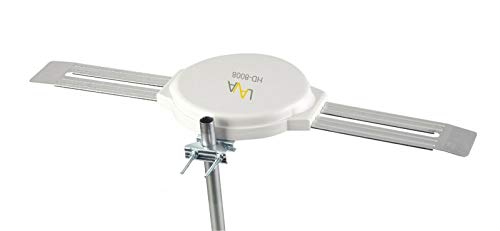
The Lava OmniPro HD-8008 is the long-range option in this guide and the one built most clearly around serving a whole household. Lava advertises a range of about 125 miles and states that the antenna can support up to 8 televisions, which makes it the natural pick for a larger home where one antenna feeds several rooms. The manufacturer manual lists a nominal reception range of 40 to 80 miles, so the 125-mile figure should be read as an ideal-condition claim and the manual range as the more conservative expectation.
The HD-8008 receives FM, VHF, and UHF signals, with a listed gain of 28 dB on VHF and 32 dB on UHF, a noise figure of 3 dB or less, and a maximum output level of 108 dBµV. It uses a 75-ohm impedance and a DC 12V power supply with an included power inserter and AC/DC adapter. Product dimensions are about 16.2 inches by 11.1 inches by 4.1 inches, and the antenna ships with a 40-foot RG6 coaxial cable, mounting accessories, and a splitter for connecting multiple televisions. The housing carries an anti-UV coating and a waterproof design, and the unit is designed for attic or roof mounting with no pointing or tuning required once installed.
This model fits a household that wants maximum range and multi-TV support from a single installation, especially in a rural or suburban location where towers are distant and spread out. Its limitations are the optimistic headline range figure, which deserves a realistic reading, and the fact that its performance still depends on local terrain and tower distance, as with any antenna. The included splitter and long cable, however, remove two common extra purchases, and the one-year manufacturer warranty adds some reassurance.
Pros:
– Longest claimed range in this guide, with VHF, UHF, and FM reception
– Supports up to 8 televisions with a splitter included in the box
– Built-in high-gain, low-noise amplifier
– Waterproof, UV-resistant housing for attic or roof mounting
Cons:
– The 125-mile headline range is optimistic; the manual suggests a lower nominal range
– Results depend heavily on local terrain and tower distance
– Larger than the compact dome, so it needs a suitable mounting spot
Comparison: Which One Fits You
Choose the Antennas Direct ClearStream 4 if your local stations are mostly UHF and you want the longest proven track record with a complete outdoor mounting kit. Its high gain and 70+ mile rating give it the most headroom for suburban homes with scattered towers, provided you have room for its wide loop panel.
Choose the ANTOP UFO AT-415B if you want the most discreet installation, need VHF as well as UHF, or plan to use the antenna on an RV. Its compact dome, switchable amplifier, and built-in LTE filter make it the most versatile of the three for mixed locations, and the 33-foot cable in the box covers most attic and roof runs.
Choose the Lava OmniPro HD-8008 if you need to feed several televisions or your towers are far away. Its multi-TV support, long included cable, and high gain are built for that job, but check your signal report first: if your stations are all within 40 miles, the smaller and simpler ANTOP dome will serve you just as well.
If your channel list includes VHF stations, narrow the choice to the ANTOP or the Lava. If it is UHF only, all three are in play, and the decision turns on range, mounting space, and how many televisions you need to feed.
Frequently Asked Questions
What is the difference between a multi directional antenna and a directional antenna?
A multi directional antenna receives signals from all directions at once, so it does not need to be aimed at a specific tower or rotated when you change channels. A directional antenna concentrates its reception in one narrow direction, which gives it more gain toward a single tower cluster but means it can miss stations broadcasting from other directions.
Do I still need to aim a multi directional antenna?
No aiming is required for the reception pattern itself, but placement still matters. Mount the antenna as high as practical, keep it clear of metal objects and foil-backed insulation, and avoid placing it behind large appliances. A higher, clearer spot almost always pulls in more channels than a lower, obstructed one.
How many channels can I expect to receive?
That depends entirely on your location, distance from the towers, terrain, and the height of your installation. Households in metro areas often receive dozens of free channels, while rural homes may receive fewer. A signal report for your address gives a far better estimate than any advertised channel count.
Can one antenna feed more than one television?
Yes, with a splitter. The Lava OmniPro HD-8008 includes a splitter and is rated for up to 8 televisions. Splitting divides the signal, so a home feeding several sets should choose an amplified model and keep cable runs as short as practical.
Do multi directional antennas work in an attic?
They can, and an attic mount is a common compromise when a roof mount is not possible. Attic reception is usually weaker than roof reception because roofing, insulation, and ductwork absorb signal, so an amplified model with a longer rated range is the safer choice for attic use.
Will a multi directional antenna work with my smart TV?
Yes, if your television has a built-in ATSC tuner, which nearly all televisions sold in the United States do. Connect the coaxial cable to the antenna input, run a channel scan from the TV menu, and the set will list the free over-the-air channels it finds.
Conclusion
The best multi directional antennas remove the most annoying part of cord cutting: aiming and re-aiming. The Antennas Direct ClearStream 4 leads on proven range and gain for UHF-heavy markets, the ANTOP UFO AT-415B offers the most discreet and versatile installation with VHF and UHF coverage, and the Lava OmniPro HD-8008 is the pick for distant towers and households feeding several televisions. Check a signal report for your address, confirm which bands your local stations use, and match the antenna to your mounting options. Any of the three will pull in free local channels from every direction without a rotor, and the right one is the one that fits your distance, your bands, and your home.
Disclosure: As an Amazon Associate, we earn from qualifying purchases.