Key takeaways
- Compare the best runner rugs for hallways: five picks from a washable two-piece system to a 12-foot rubber-backed solid, with sizes, fibers and backings.
Quick answer: For most hallways, the Ruggable Kamran Hazel runner is the all-round pick: a two-piece system in which a flat-woven chenille cover, 30 x 84 inches, sits on a separate non-slip pad, and the cover alone goes in the washing machine when the traffic line gets dirty. If the hall wants a traditional woven rug instead, the SAFAVIEH Adirondack is the patterned pick, a power-loomed runner with a three-eighths inch pile that needs a pad of its own because its jute back has no grip. The Lahome Moroccan is the ultra-thin washable pick, the Maples Reggie is the American-made rubber-backed pick, and the Ottomanson Ottohome solid is the long pick, a single 12 foot piece for halls the standard lengths cannot cover. Widths run from 22 to 30 inches, so measure the hall and the door swings first.
As an Amazon Associate, we earn from qualifying purchases.
Table of Contents
- Why a Runner Is Not Just a Narrow Rug
- How to Choose a Runner Rug
- Quick Comparison
- 1. Ruggable Kamran Hazel Runner with Standard Pad
- 2. SAFAVIEH Adirondack Runner Rug, ADR109V
- 3. Lahome Moroccan Hallway Runner Rug
- 4. Maples Rugs Reggie Floral Runner Rug
- 5. Ottomanson Ottohome Solid Rubberback Runner
- Before You Buy: Fit, Grip and Safety Checks
- FAQ
- Conclusion
Why a Runner Is Not Just a Narrow Rug
A runner does a different job from an area rug, and the job explains the form. An area rug is anchored by furniture: a sofa front, a coffee table and chair legs pin it to the floor and forgive a backing with no grip of its own. A runner is anchored by nothing. It lies alone in the one part of the house where traffic is single file and constant, where shoes arrive carrying grit from the door and the same narrow line of floor is crossed hundreds of times a day in the same direction. Everything about the category follows: widths of roughly two to three feet because halls are narrow, lengths from six feet to twelve and beyond because halls are long, and low piles because doors swing over runners.
The second difference is movement. A rug that creeps an inch a week under a sofa is invisible; a runner that creeps an inch a week ends up bunched against a door, and a bunched runner is a trip edge in the darkest part of the house. That is why the picks here divide by grip system rather than by pattern: two-piece systems that separate the walking surface from a gripping pad, rubber backings bonded to the rug itself, and one traditional power-loomed rug whose jute back grips nothing and which is sold, honestly, as a rug that needs a pad bought separately. All five picks are described from their published specifications.
How to Choose a Runner Rug
Measure the hall, then leave a border. A runner should not wall itself edge to edge. The working layout leaves a border of bare floor visible on both sides, a few inches in a standard hall, which centers the rug visually and keeps its edges off the baseboards where vacuum heads catch them. Widths in this guide run from the Ottomanson at 22 inches, sized for narrow halls and galley kitchens, to the 30 inch width shared by the Ruggable, the SAFAVIEH and the Maples. Length runs the other way: cover the traffic line, and stop short of the door swings at each end.
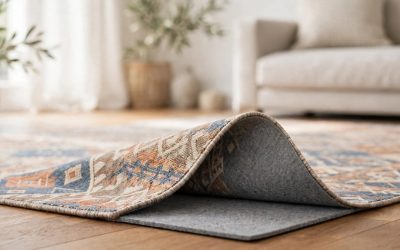
Decide how the rug will stay put. Three answers appear here. The Ruggable separates the jobs: a gripping pad stays on the floor and the cover attaches to it, so the walking surface can be removed and washed without moving the grip layer. The Lahome, the Maples and the Ottomanson bond the grip to the rug, a rubber or thermoplastic rubber backing that holds on hard floors and comes up with the rug when it is lifted. The SAFAVIEH has no grip layer at all: its jute back is the traditional construction, and on hardwood or tile it requires a separate rug pad, a real second purchase that belongs in the comparison.
Treat pile height as a door measurement. Doors are the ceiling of a hallway. A runner too thick for the gap under a door will be planed by the door’s bottom edge every time it swings, and the wear shows in a line across the pile. The Ottomanson publishes a 0.2 inch pile for its Ottohome rubberback line, the thinnest here, and the Lahome is sold as an ultra-thin design; the SAFAVIEH’s published pile is three-eighths of an inch, the deepest here and still a low pile by rug standards. Measure the clearance under the hall’s doors before ordering.
Read washable as a system, not a word. Three of the five picks are sold as machine washable, and they wash differently. The Ruggable washes only its cover, a flat-woven piece that fits a standard machine because the pad stays home. The Lahome and the Maples wash whole, which their thin, flexible builds allow, but an eight foot runner is a large load and the machine’s capacity is part of the spec. The SAFAVIEH and the Ottomanson are not sold as machine washable in the listing data reviewed; their care is vacuuming and spot cleaning.
Match the fiber to the traffic. Polypropylene, the SAFAVIEH’s main pile fiber, is the non-shedding workhorse of power-loomed rugs and shrugs off tracked-in grit. Polyester, the Lahome’s and the Maples’ published fiber, holds printed and dyed color well. The Ruggable’s chenille cover is the softest surface here, a flat weave rather than a cut pile. The Ottomanson’s nylon is the commercial answer: a flat, hard-wearing pile that does not shed and does not pretend to be plush.
Quick Comparison
| Product | Tier | Grip system | Construction | Dimensions |
|---|---|---|---|---|
| Ruggable Kamran Hazel Runner | Premium | Separate non-slip pad, two-piece system | Flat-woven chenille cover | 30 x 84 in |
| SAFAVIEH Adirondack ADR109V | Mid-range | Jute back, pad required | Power-loomed | 30 x 96 in |
| Lahome Moroccan Hallway Runner | Mid-range | Thermoplastic rubber backing | Machine made, ultra-thin | 29 x 96 in |
| Maples Rugs Reggie Runner | Budget | Rubber backing | Machine made | 30 x 72 in |
| Ottomanson Ottohome Solid Runner | Budget | Rubber backing | Machine made, flat pile | 22 x 144 in |
1. Ruggable Kamran Hazel Runner with Standard Pad
The Ruggable is the all-round pick because it is the only design here that treats washing and gripping as separate problems and solves both. The system has two pieces: a non-slip pad that stays on the floor, and a flat-woven chenille cover in the Kamran Hazel pattern, a distressed vintage medallion in browns, honey beige and creams per the maker’s published description, that attaches over it. When the traffic line gets dirty, the cover peels off and goes in a standard washing machine, and the pad never moves. The listing covered here is the 30 x 84 inch runner with the Standard pad; the same design is sold with a thicker cushioned pad under a different listing, so check which pad a listing names.
The published figures are modest and specific. The product information lists the cover’s material as chenille with a flat weave, the item weight as 6.8 pounds for the system, and the material features as durable, stain resistant and water resistant. The maker’s published description adds that the pad is latex-free, that the cover is made in the USA with imported materials, and that the design carries a water-resistant barrier to keep spills from reaching the floor. What the system asks in return is alignment: a cover laid back carelessly will overhang on one side, and the flat cover has none of the body of a woven rug, the trade every two-piece design makes. A crawl of this listing showed the summary line that no featured offer was available, so confirm the live offer before ordering.
Specs
- Pieces: 2, rug cover and Standard rug pad
- Dimensions: 30 x 84 in (2.5 x 7 ft)
- Material: Chenille cover, flat woven, per the product information
- Grip system: Separate non-slip pad, latex-free per the maker’s published description of the system
- Care: Machine washable cover, per the listing
- Model: RUG-SYS-IND-RCT-CHN-JB003-02×07
- Color covered here: Kamran Hazel, with Standard Pad
- Weight: 6.8 lb, per the product information
- Warranty: Not stated in the listing data reviewed
2. SAFAVIEH Adirondack Runner Rug, ADR109V
The SAFAVIEH is the traditional pick: a power-loomed runner in the Adirondack collection’s distressed vintage floral pattern, in Ivory and Sage at 30 x 96 inches, built the way woven rugs have been built for decades and making no washable claims at all. The maker’s published data for the Adirondack line gives the construction plainly: power-loomed in Turkey from a blend of 55 percent polypropylene, 40 percent jute and 5 percent polyester, with a pile height of three-eighths of an inch and a non-shedding face. That pile is the deepest in this guide, and it reads as a real rug underfoot rather than a printed mat.
The honest cost of the construction is the back. Published line data gives the Adirondack a jute backing, and jute grips nothing: on hardwood, tile or laminate this runner will travel unless a separate non-slip rug pad goes under it, and the pad is not included. Buy the two together and treat the pair as the product. In exchange, the polypropylene face is the easiest here to keep looking clean with a vacuum alone, and the distressed pattern hides tracked-in dust better than any solid in this guide. The listing data reviewed does not publish an item weight or a warranty term for this colorway, so both are marked Not stated below.
Specs
- Pieces: 1, rug pad not included
- Dimensions: 30 x 96 in (2.6 x 8 ft)
- Material: Power-loomed blend of 55 percent polypropylene, 40 percent jute and 5 percent polyester, per the maker’s published data for the Adirondack line
- Pile height: 3/8 in, per published line data
- Backing: Jute, per published line data; no grip layer, a separate rug pad is required on hard floors
- Care: Easy care per the listing; not a machine-washable design
- Model: ADR109V-28
- UPC: 889048191914
- Color covered here: Ivory and Sage
- Weight: Not stated in the listing data reviewed
- Warranty: Not stated
3. Lahome Moroccan Hallway Runner Rug
The Lahome is the ultra-thin washable pick: a machine made polyester runner, 29 x 96 inches in the Cream and Multi colorway the listing calls Elise, printed with a vintage Moroccan trellis and floral pattern and bonded to a thermoplastic rubber backing. Where the Ruggable separates its grip into a second piece, the Lahome’s grip is the rug’s own back, so the whole runner lifts, washes and goes back down as one object. The listing positions the design as ultra-thin, and that profile is its working trait: it sits low enough for door swings and robot vacuums that would balk at a woven pile, and it folds for the wash instead of fighting the machine.
The published data is a listing block rather than a maker’s manual, and the Specs below stay inside it: polyester as the material, machine made construction, thermoplastic rubber as the back material, machine wash as the care instruction, and non slip and washable as the published features. The trade against the Ruggable is feel and finish: a printed ultra-thin runner reads as a mat with a pattern rather than a rug with a pile. The listing data reviewed publishes no numeric pile height, no item weight and no warranty term, so all three are marked Not stated below.
Specs
- Pieces: 1
- Dimensions: 29 x 96 in (2 ft 5 in x 8 ft)
- Material: Polyester, per the listing data
- Construction: Machine made, per the listing data
- Profile: Ultra-thin per the listing; numeric pile height Not stated in the listing data reviewed
- Backing: Thermoplastic rubber (TPR), per the listing data
- Care: Machine wash, per the listing data
- Model name: Moroccan Hallway Runner Rug, as published in the listing data
- UPC: 810139070498
- Color covered here: Cream/Multi (Elise)
- Weight: Not stated in the listing data reviewed
- Warranty: Not stated
4. Maples Rugs Reggie Floral Runner Rug
The Maples Reggie is the American-made pick: a machine made runner, 30 x 72 inches in Dark Grey, carrying a bold bohemian floral in green, blue, yellow and orange across its face per the maker’s published description, with a rubber backing doing the gripping. Maples publishes the line as made in the USA, and the maker dates its rug making to 1966. The six foot length is the shortest here, which suits the short hall and the galley kitchen run better than the eight foot standard.
This listing’s own product information prints the fiber as polyester and the back material as rubber, with fade resistant, non slip, stain resistant and washable among its published features, and the Specs block follows that block. The caution, flagged in full in the checks section, is that other Reggie listings in the same line print nylon as the material; this guide describes the runner by its own listing’s figures. What is consistent across the line’s data is the low pile and the skid-resistant backing: a patterned, washable, gripping runner at the budget tier. The listing data reviewed does not publish an item weight for this size or a warranty term, so both are marked Not stated below.
Specs
- Pieces: 1
- Dimensions: 30 x 72 in (2.6 x 6 ft)
- Material: Polyester, per this listing’s product information (other listings in the Reggie line print nylon; see the checks section)
- Backing: Rubber, per this listing’s product information
- Construction: Machine made, per the listing data; made in the USA per the listing
- Pile: Low pile, per the maker’s published data for the line
- Care: Machine washable, per the listing data
- Model: L5974F14 (model name Reggie)
- UPC: 010892725417
- Color covered here: Dark Grey
- Weight: Not stated for this size in the listing data reviewed
- Warranty: Not stated
5. Ottomanson Ottohome Solid Rubberback Runner
The Ottomanson is the long pick, and its spec sheet is a single argument: 22 x 144 inches, one continuous solid black runner for the hall that runs from the front door to the back of the house, or the basement corridor no standard length covers without a seam. It comes from the maker’s Ottohome rubberback line, whose published data gives a non-slip rubber backing and a pile thickness of 0.2 inches, the thinnest profile in this guide. At that thickness the runner clears door bottoms that would plane a woven rug and asks nothing of the floor plan except length.
The surface is nylon per the maker’s published description of the line, a flat commercial-style pile that does not shed and does not try to be soft; the listing data for this size adds stain resistance and easy cleaning. This is the pick that treats the hallway as infrastructure. It will not warm a room the way the SAFAVIEH’s pile does or carry a pattern the way the Maples does, and its 22 inch width is the narrowest here, sized for tight halls. In exchange it covers twelve feet in one piece and grips without a pad. The listing data reviewed does not publish an item weight or a warranty term for this size, so both are marked Not stated below.
Specs
- Pieces: 1
- Dimensions: 22 x 144 in (1 ft 10 in x 12 ft)
- Material: Nylon, per the maker’s published description of the Ottohome rubberback line
- Pile height: 0.2 in, per the maker’s published data for the line
- Backing: Rubber, non-slip, per the listing data
- Care: Easy clean per the listing; machine washing not published for this size in the listing data reviewed
- Model: OTH8403-2X12
- UPC: 849928057075
- Color covered here: Black
- Weight: Not stated in the listing data reviewed
- Warranty: Not stated
Before You Buy: Fit, Grip and Safety Checks
Measure the hall, the doors and the machine. Width first: the hall’s clear width minus a border of a few inches on each side gives the runner width, and the five picks span 22 to 30 inches. Length second: run the tape along the traffic line and stop the rug short of every door swing. Doors third: the gap under the lowest hall door is the maximum pile the hall accepts, and the figures here run from the Ottomanson’s 0.2 inches to the SAFAVIEH’s three-eighths of an inch. If the pick is washable, the last measurement is the washing machine: an eight foot runner is a bulky load even when thin, and the Ruggable’s cover-only wash answers that limit.
Reconcile the conflicting figures before they reach your hall. Two picks carry data that needs a decision. The Maples Reggie’s own listing prints polyester as the material and rubber as the back, while other listings in the same Reggie line print nylon; this guide follows the runner’s own listing, and a buyer choosing the Reggie for its fiber should confirm the fiber on the delivered rug’s label. The Ruggable listing covered here is the Standard Pad bundle: the same Kamran Hazel runner is sold with a thicker cushioned pad under a separate listing, and the two are not interchangeable orders. A crawl of the Ruggable listing also showed the summary line that no featured offer was available, a reason to confirm the live offer and the pad type before ordering, not a statement that the rug is out of production.
Treat grip as the safety specification. A runner’s failure mode is movement, and movement in a dark hall is a fall. The bonded rubber backings here, and the Ruggable’s separate pad, exist to prevent it; the SAFAVIEH’s jute back does not, and ordering that rug without a pad leaves the job half done. Whatever the backing, a new runner arrives rolled and its ends will curl until they relax: unroll it, weight the ends, and do not judge the fit until it lies flat. Recheck the grip after the first wash of any washable pick.
A note on recalls. None of the five products in this guide, and none of these brands’ runner lines, appears in a CPSC recall. The rug recall on the current record is a different failure from a different class of product: in November 2026 the CPSC recalled Boshengya shag area rugs, 83 units sold online, because they violated the mandatory federal flammability standard for carpets and rugs. Every carpet and rug sold in the United States sits under that flammability framework, and the standing advice applies to this category more than most: check an exact model number on saferproducts.gov before buying, which remains the cheapest two minutes in the process.
FAQ
How wide should a hallway runner be?
Wide enough to carry the traffic and narrow enough to leave a border of floor showing on both sides. In a standard hall that usually lands between 24 and 30 inches: three of the picks here are 30 inches wide and the Lahome is 29. The exception is the narrow hall and the galley kitchen, where the Ottomanson’s 22 inch width keeps the rug off the baseboards. A runner that touches both walls reads as carpet offcut; a runner with a border reads as a rug.
Does a runner rug need a rug pad?
It needs grip, and the pad is only one way to get it. The Ruggable builds the grip into a separate pad that is part of the system, and the Lahome, the Maples and the Ottomanson bond rubber backings to the rug itself, so none of the four needs a second purchase. The SAFAVIEH does: its jute back has no grip layer, and on a hard floor a separate non-slip pad is part of the cost of that pick.
Can you machine wash a runner rug?
Three of the five picks are sold as machine washable, in two different senses. The Ruggable washes its cover only, with the pad left on the floor, which keeps the load small. The Lahome and the Maples wash whole, which their thin, flexible constructions allow, though an eight foot runner tests a domestic machine’s capacity. The SAFAVIEH and the Ottomanson are not sold as machine washable in the listing data reviewed; both are vacuum and spot clean designs.
How long should a runner be for a hallway?
Long enough to cover the traffic line in one piece, and short enough to stop before the doors at each end swing onto it. Standard halls take the six to eight foot lengths most of this guide covers: the Maples at six feet for short runs, the Ruggable at seven, the SAFAVIEH and the Lahome at eight. Long halls and basement corridors are the Ottomanson’s case: twelve feet in a single piece, with no seam for feet to catch and no gap for grit to collect in.
Conclusion
Start with the hall’s width, its door swings and whether the rug will ever meet a washing machine, and the list narrows itself. For the hallway that gets muddy and busy, the Ruggable is the all-round pick: the only design here whose walking surface washes while its grip stays on the floor. Choose the SAFAVIEH when the hall wants a real woven rug with a patterned pile, and budget the pad it requires as part of the same order. Take the Lahome for the ultra-thin washable profile that clears every door, the Maples for the American-made rubber-backed floral at the budget tier, and the Ottomanson when the hall is longer than the standard lengths and one unbroken twelve foot piece is the whole requirement. Match the grip to the floor and the length to the traffic line, and any of the five turns the most crossed strip of floor in the house into the most finished one.