Our Short List of 3

- Best for: Long dining tables and seating rows on patios with steady wind.
- Canopy: 10 x 13 ft rectangular
- Fabric: 240 GSM yarn-dyed polyester; UV resistant and water repellent
- Frame: reinforced aluminum
- Ribs: 8 powder-coated aluminum ribs

- Best for: Open, unsheltered decks that need the heaviest anchor in this roundup.
- Canopy: 11 ft round, about 95 sq ft of shade
- Fabric: 250 g/m² polyester with PU coating; UV protected, fade resistant and water resistant
- Pole: powder-coated aluminum, 2.4 in diameter
- Ribs: 8 heavy-duty steel ribs
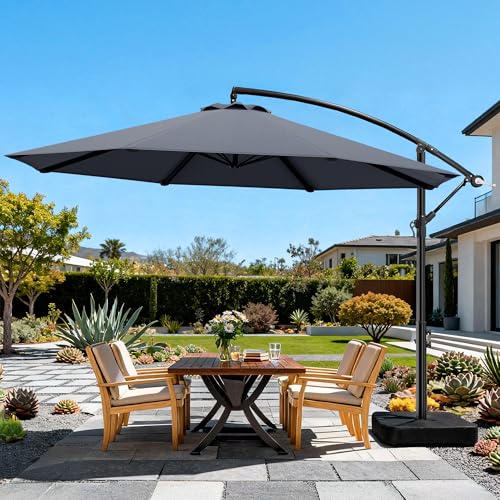
- Best for: A first cantilever on a mid-size patio, with base, sandbags and cover in one box.
- Canopy: 10 ft, about 100 sq ft of shade
- Fabric: 220 gsm yarn-dyed fabric with PU coating
- Pole: powder-coated steel
- Ribs: 8 heavy-duty steel ribs
All 5 Picks at a Glance
| Product | Specs | Action |
|---|---|---|
| PURPLE LEAF 10 x 13 Cantilever Umbrella |
| Check price on Amazon |
| Grand Patio 11FT Cantilever Umbrella with Base |
| Check price on Amazon |
| OLILAWN 10ft Cantilever Umbrella with Base |
| Check price on Amazon |
 LAUSAINT HOME 11FT Curvy Cantilever Umbrella |
| Check price on Amazon |
 GarveeLife 10FT Cantilever Umbrella |
| Check price on Amazon |
Key takeaways
- Compare five cantilever umbrellas built for breezy patios by vented canopy design, frame and rib materials, and the filled base weight each listing states.
A cantilever umbrella lives or dies by wind. The canopy hangs off a side arm with no center pole to brace it, so every gust works like a hand pushing a sail on a lever. The real decision is not the shade size but the wind plan: which canopy lets gusts escape, which frame and ribs hold their shape, and how many pounds of base stand between a breezy afternoon and a tipped, twisted umbrella in the pool.
This roundup is for exposed patios, rooftop terraces, lakeside decks and open gardens where shelter is scarce. The five picks were chosen from their Amazon listings: wind wording and vent designs in the listing copy, frame and rib materials, stated base fill weights, and whether the base ships in the box. Every figure below comes from the listing for that exact model.
Quick Picks
As an Amazon Associate we earn from qualifying purchases
| Product | Best for | Key spec from title |
|---|---|---|
| PURPLE LEAF 10 x 13 Cantilever Umbrella | Long tables on exposed patios | 10 x 13 ft canopy with double-roof vent |
| Grand Patio 11FT Cantilever Umbrella with Base | Open decks that need maximum base weight | Wheeled base fills to 374 lb |
| OLILAWN 10ft Cantilever Umbrella with Base | A complete kit with base and sandbags in the box | 220 gsm yarn-dyed canopy, vented top |
| LAUSAINT HOME 11FT Curvy Cantilever Umbrella | Heaviest included sandbag base | Four sandbags, about 308 lb filled |
| GarveeLife 10FT Cantilever Umbrella | Smaller patios, lighter complete setup | 120 in canopy, aluminum frame |
How to Choose
A Vented or Double Top Lets Gusts Escape
Wind lifts a cantilever canopy from underneath, and a sealed top gives that pressure nowhere to go. Vented designs solve this at the fabric level: a double-roof canopy leaves a gap at the crown, and a single vented top opens a smaller escape route, so gusts pass through instead of shoving the whole span sideways. When you read listings, look for the vent described in the special features or the canopy description, not just in a headline. A vent does not replace base weight, but it lowers the force the base and frame have to fight.
Frame and Rib Materials Decide What Flexes
The frame is the second line of defense. Aluminum poles resist rust and keep the unit movable, while steel poles add stiffness at the cost of weight. Ribs matter just as much: eight is the working standard in this group, and heavy-duty steel ribs hold a wide canopy flatter in a gust than thin alloy arms. Pole diameter is a useful shortcut, since a 2.4 inch pole sways less than a slim one under the same load. Powder coating is worth checking too, because a frame that lives outside all season needs its finish to survive rain as well as sun.
Base Weight Is the Anchor, So Read the Fill Numbers
Every cantilever canopy hangs off a side arm, which makes the base the anchor for the whole structure. Listings state fill weights, and the spread here is wide: about 130 pounds of sand on the lightest included base, roughly 308 pounds of sandbags on the heaviest, and 374 pounds of sand and water on the wheeled tank. Check three things before ordering: whether a base is in the box at all, what fills it, and whether the filler itself is included, because sand almost never is. Wheels only help before filling; once a base is loaded, it stays where it sits.
Tilt, Rotation and a Fast Close Matter in Gusts
Adjustment hardware doubles as wind management. A canopy tilted steeply presents less flat area to a gust than one held level, and rotation lets you swing the span parallel to a fence or wall instead of broadside to the breeze. Just as important is how fast the umbrella closes: a smooth crank and a strap to bind the folded canopy are what protect the fabric when weather turns suddenly. Listings that mention a windproof strap or an included cover are telling you the maker expects the umbrella to be secured, not left open and forgotten.
The 5 Best Options
PURPLE LEAF 10 x 13 Cantilever Umbrella
- Best for: Long dining tables and seating rows on patios with steady wind.
- Canopy: 10 x 13 ft rectangular
- Fabric: 240 GSM yarn-dyed polyester; UV resistant and water repellent
- Frame: reinforced aluminum
- Ribs: 8 powder-coated aluminum ribs
Long dining tables and seating rows on patios with steady wind.
The base and a protective cover are separate purchases, so the setup is not complete out of the box.
Pick the PURPLE LEAF if your patio takes steady wind and you want the canopy itself to do part of the work. Its double-roof design leaves a vented gap at the top, so gusts pass through instead of lifting against a sealed canopy, and the listing states the reinforced aluminum frame is built for wind speeds up to 35 MPH. The rectangular 10 by 13 foot canopy suits a long dining table, six angle positions and full rotation keep shade on the seats, and eight aluminum ribs hold the wide span.
Grand Patio 11FT Cantilever Umbrella with Base
- Best for: Open, unsheltered decks that need the heaviest anchor in this roundup.
- Canopy: 11 ft round, about 95 sq ft of shade
- Fabric: 250 g/m² polyester with PU coating; UV protected, fade resistant and water resistant
- Pole: powder-coated aluminum, 2.4 in diameter
- Ribs: 8 heavy-duty steel ribs
Open, unsheltered decks that need the heaviest anchor in this roundup.
The base must be filled where it will stand; 330 lb of sand is a job in itself and is not included.
The Grand Patio answers wind with weight rather than vents. Its wheeled polyethylene base fills with 330 pounds of sand plus 44 pounds of water, and that 374 pound anchor is what keeps an 11 foot canopy planted on an open deck. The frame pairs a thick 2.4 inch aluminum pole with eight heavy-duty steel ribs, the crank lifts the canopy smoothly, and tilt runs to 90 degrees with an auto-lock, so you can angle the canopy steeply when a low sun and a crosswind arrive together.
OLILAWN 10ft Cantilever Umbrella with Base
- Best for: A first cantilever on a mid-size patio, with base, sandbags and cover in one box.
- Canopy: 10 ft, about 100 sq ft of shade
- Fabric: 220 gsm yarn-dyed fabric with PU coating
- Pole: powder-coated steel
- Ribs: 8 heavy-duty steel ribs
A first cantilever on a mid-size patio, with base, sandbags and cover in one box.
Its 130 lb base capacity is the lightest here, so it suits breezy patios rather than fully exposed sites.
OLILAWN builds its wind case into the listing itself: the special features name a vented, windproof design, and a Velcro strap ties the canopy down when gusts pick up. Eight steel ribs and a powder-coated steel pole carry the 10 foot canopy, while the included cross base and two sandbags hold up to 130 pounds of sand. It is the most complete box here for a mid-size patio, with rotation, tilt adjustment and a cover included, so the setup is finished the day it arrives.
LAUSAINT HOME 11FT Curvy Cantilever Umbrella
- Best for: Buyers who want the heaviest sandbag base included rather than a plastic tank.
- Canopy: 11 ft round, curvy offset design
- Fabric: heavy polyester canopy
- Frame: aluminum pole and frame
- Adjustment: 360° rotation by pedal; infinite tilt
Buyers who want the heaviest sandbag base included rather than a plastic tank.
Once the four sandbags are filled the base is effectively permanent, so settle the position first.
The LAUSAINT HOME curvy 11 footer is for buyers who want the anchoring handled by sandbags rather than a plastic tank. Its fabric-covered base packs four sandbags that total about 308 pounds when filled, the heaviest included base in this roundup, and the listing labels the umbrella windproof with a vented top. An aluminum pole and frame keep the structure lighter than the filled base suggests, a pedal spins the canopy 360 degrees, and the tilt adjusts continuously instead of clicking between fixed notches.
GarveeLife 10FT Cantilever Umbrella
- Best for: Smaller patios that need an offset umbrella with its base in the box.
- Canopy: 10 ft round, 120 in diameter
- Fabric: polyester; UPF 50+ sun protection
- Frame and shaft: aluminum
- Ribs: 8
Smaller patios that need an offset umbrella with its base in the box.
The product information lists manual lift and tilt rather than a crank, and the lighter build needs a sheltered placement.
GarveeLife is the lighter route into this group: the listing calls the 10 foot offset umbrella windproof, includes a base in the box, and keeps the whole unit at 45.4 pounds before ballast. An aluminum shaft and frame carry a polyester canopy with UPF 50+ sun protection, eight ribs support the span, and the head rotates 360 degrees to follow the sun. It suits a smaller patio where a 300 pound base is not practical, as long as the spot is not the windiest corner you own.
Which One Fits Your Situation
A Rooftop Terrace or Lakeside Deck With Steady Wind
Constant wind rewards the canopy that sheds it. The PURPLE LEAF pairs a double-roof vent with a reinforced aluminum frame the listing describes for wind speeds up to 35 MPH, so gusts bleed through the crown instead of building under a sealed top. Budget for its separate base, and weight that base toward the heavy end, because the vent reduces force rather than removing it.
A Wide Open Backyard With No Shelter at All
With no fence or wall to break the weather, base weight does the work. The Grand Patio fills its wheeled base to 374 pounds, the heaviest anchor here, and backs it with eight steel ribs on a 2.4 inch pole. Roll it into place empty, fill it there, and treat that spot as its home for the season.
A Mid-Size Patio and a First Cantilever
If this is your first offset umbrella, the OLILAWN removes the guesswork: cross base, two sandbags and a cover are in the box, the top is vented, and a strap secures the canopy when the wind picks up. Fill the bags fully, all 130 pounds the base accepts, because a half-filled base is where most tipping stories begin.
A Smaller Patio Where a Huge Base Will Not Fit
When floor space is tight, the GarveeLife keeps the footprint modest: a 10 foot canopy, an included base and a 45.4 pound unit that is easier to place than the big-tank models. Its listing labels it windproof, but the lighter build means placement matters more, so tuck it toward the sheltered side of the patio and close it when gusts build.
Common Mistakes
- Judging wind readiness by the word windproof alone, without checking the vent design, rib material and base fill weight behind it.
- Leaving the canopy open in a storm because the listing mentions wind; every design here still expects the umbrella closed and strapped in severe weather.
- Ordering a model whose base is sold separately, then improvising with a light stand that the canopy will lever over.
- Filling sandbags or a tank only partway to save effort, which removes exactly the anchor weight the design counts on.
- Parking the base where the rotating canopy swings into a railing, wall or tree, then blaming the frame when the fabric tears.
Frequently Asked Questions
What makes a cantilever umbrella handle wind better than a basic one?
Three things working together: a vent or double top that lets gusts escape instead of lifting the canopy, a frame and ribs stiff enough to hold the span flat, and enough base weight to anchor the side arm. A basic offset umbrella may have one of these; the picks here combine at least two, and the strongest combine all three.
How much base weight does a cantilever umbrella need?
Follow the fill figure in the listing for your exact model, because the maker sized it to the canopy. In this roundup the stated numbers run from 130 pounds of sand on a 10 foot kit to 374 pounds of sand and water on an 11 foot model. Bigger canopies and windier sites belong at the heavy end of that range.
Should I leave a wind-resistant cantilever umbrella open in a storm?
No. Wind wording in a listing describes how the design copes with ordinary breezes and gusts, not severe weather. Close the canopy, bind it with its strap, and use a cover when one is included or available. The vent, frame and base weight buy margin on a gusty afternoon; they are not a reason to leave any large canopy open in a storm.
Does a double-top canopy really help in gusts?
Yes, within limits. The raised second layer leaves an opening at the crown, so air building under the canopy has an exit instead of pressing against a sealed surface. That reduces the lift and sideways shove the frame and base must absorb. It does not anchor the umbrella by itself, which is why double-top models still need a properly filled base.