Key takeaways
- Compare the best floor vases, from a 28-inch ceramic piece to a 49-inch gold fiberglass vase, with height, material and stability notes for each pick.
For most living rooms, the right floor vase is the one matched to the job it has to do: a tall ceramic piece that anchors a bare corner, a set of metal vases that fills a long wall in graduated heights, or a sculptural statement vase that holds the room on its own even when it is empty. Floor vases split along those job lines, and the job matters more than the silhouette. A vase bought to anchor a corner is judged on its height, its base width and whether it stays upright when a dog brushes past it; a vase bought as a set is judged on whether the graduated heights actually read as a group; a vase bought as a sculpture is judged on its material and finish, because nothing will ever hide them. This guide compares five floor vases across those three jobs: a 28-inch white ceramic vase with a striped glaze, a set of three black metal vases in graduated heights, a 33-inch mother of pearl mosaic vase, a tall mango wood vase in gold, and a 49-inch gold fiberglass vase, with the dimensions, materials and stability notes that decide how each one actually behaves on a floor.
As an Amazon Associate, we earn from qualifying purchases.
Table of Contents
- Floor Vases Do Three Different Jobs
- How to Choose the Right Floor Vase
- Quick Comparison
- 1. GDSZJLJ White Tall Floor Vase, 28-Inch Ceramic
- 2. Sziqiqi Large Black Vases Tall 27-Inch Set of 3
- 3. Deco 79 Mother of Pearl Handmade Tall Mosaic Vase, 33-Inch
- 4. LEEWADEE Large Floor Vase, 36-Inch Mango Wood, Golden
- 5. Z Gallerie Accolade Vase, 48.75-Inch Gold Fiberglass
- Before You Buy: Floor Vase Checks
- Frequently Asked Questions
- Conclusion
Floor Vases Do Three Different Jobs
A floor vase is not one product category wearing five costumes. It is three different objects that happen to stand on the same floor, and a guide that grades them on one scale misleads buyers in both directions — the tallest vase in this guide would be a poor choice for a small apartment, and the most practical set here would disappoint anyone who bought it for the drama of a single statement piece. Read the five picks below against the job you actually have.
Anchoring a Corner Is the First Job
The first job is architectural: filling a bare corner, the dead space beside a sofa arm, or the gap between a bookcase and a wall. A floor vase bought for this job is judged on height first — 24 to 36 inches is the range that reads as a floor piece rather than a tabletop vase that wandered off its shelf — and on base width second, because a tall vase with a narrow base is a vase waiting to be knocked over. The GDSZJLJ ceramic vase and the LEEWADEE wood vase both do this job: they stand alone, they hold dried stems or pampas grass, and they give a corner a vertical line it did not have. For these picks, the governing specifications are height and footprint, because a vase that is too short disappears behind the sofa and a vase that is too wide blocks the walkway.
A Set Fills a Wall, Not a Corner
The second job is grouping: three vases in graduated heights that read as one arrangement along a long wall, a fireplace hearth or an entryway console. The Sziqiqi set is the only set in this guide, and it should be graded the way a set is graded — on whether the three heights actually step down in a visible rhythm and whether the pieces work apart as well as together. A set bought for a hearth can be split across two rooms, and a set bought for a console can be rearranged when the seasons change, which is a flexibility a single vase never offers. The trade-off is that a set’s smallest piece is often too short to stand on a floor on its own, so the set belongs where the group can be seen together, not scattered into corners where the smallest vase reads as a mistake.
A Statement Vase Is Bought to Be Looked At
The third job is sculptural: a vase whose material and finish are the decor, bought to be looked at whether or not it ever holds a stem. The Deco 79 mother of pearl mosaic vase and the Z Gallerie Accolade vase both do this job — one with hand-laid shell pieces that catch the light, the other with a fluted gold fiberglass form nearly four feet tall. For these picks, the governing specifications are the material and the surface, because a mosaic that is printed rather than laid, or a gold finish that reads as plastic under daylight, fails the only test that matters. A statement vase is also the pick most likely to be bought as a gift, which makes its packaging and its weight worth checking before ordering.
How to Choose the Right Floor Vase
Start With Height, Then Measure the Room
Floor vases are sold by height, and height is the figure that decides most purchases. A vase between 24 and 36 inches tall suits a standard living room with eight-foot ceilings, standing beside a sofa or in a corner without competing with wall art or windows. The Z Gallerie Accolade vase, at nearly 49 inches, is a different proposition — it belongs in a room with high ceilings, a wide entryway or a double-height space, where its scale is the point rather than a problem. Before ordering, measure the ceiling height and the height of the furniture the vase will stand beside: a useful rule is that the vase should stand no taller than about one and a half times the height of the nearest sofa arm or console, so it reads as a companion to the furniture rather than a rival to it.
Match the Material to the Traffic
Material decides how a floor vase survives daily life. Ceramic is the classic floor vase material — heavy, stable and easy to wipe clean — but it chips and breaks if it falls, which is why the GDSZJLJ pick belongs in a low-traffic corner rather than a hallway where children run. Metal is the practical choice for busy rooms: the Sziqiqi set is lighter than ceramic and will dent rather than shatter if it is knocked, which is the right trade for a household with pets or children. Wood, like the LEEWADEE pick, brings warmth and a natural texture, but it should never hold standing water — it is a vessel for dried stems, not fresh flowers. Fiberglass, the Z Gallerie material, is the lightest way to get real height, which is why a nearly four-foot vase can be moved by one person, at the cost of a surface that shows fingerprints more readily than ceramic does.
Check the Opening Before the Stems
A floor vase is usually bought to hold something — pampas grass, dried branches, faux eucalyptus — and the opening decides what it can hold. A wide opening, like the 4.72-inch mouth on the largest Sziqiqi vase, takes a full bunch of pampas grass without crowding. A narrow opening, like the 3.5-inch mouth on the LEEWADEE vase, suits a few tall branches and forces a sparser arrangement, which is a style choice as much as a limit. The Deco 79 mosaic vase has a 10-inch square body, which gives it a broad mouth and a stable stance, while the Z Gallerie vase’s 16-inch footprint is the widest here and the reason it can stand nearly four feet tall without looking top-heavy. Count the stems you plan to use, measure the bunch, and buy the opening that fits them.
Stability Is a Specification, Not an Afterthought
A tall vase is a lever: the taller it is, the more easily a bump at the top becomes a fall. Stability comes from three things — a wide base, a low center of gravity, and weight where it counts. Ceramic and wood vases carry their weight low, which is why the GDSZJLJ and LEEWADEE picks are the most stable by geometry. Metal sets are lighter, so they belong against a wall or in a corner rather than in the middle of a traffic path. The Z Gallerie vase compensates for its light fiberglass body with a 16-inch footprint, the widest in this guide. Whatever the material, a floor vase should stand on a hard, level surface with its full footprint on the floor, out of the path where a child can reach it or a pet can knock it, and never where it can be used as a handhold.
Quick Comparison
| Product | Height | Material | Best For |
|---|---|---|---|
| GDSZJLJ White Tall Floor Vase | 28 in | Ceramic | A ceramic corner anchor |
| Sziqiqi Large Black Vases, Set of 3 | 27 in tallest | Metal | A graduated set for a long wall |
| Deco 79 Mother of Pearl Mosaic Vase | 33 in | Mother of pearl mosaic | A statement piece that catches light |
| LEEWADEE Large Floor Vase, Golden | 36 in | Mango wood | A warm wooden vase for dried stems |
| Z Gallerie Accolade Vase | 48.75 in | Fiberglass, gold finish | An extra-tall vase for high ceilings |
1. GDSZJLJ White Tall Floor Vase, 28-Inch Ceramic — Best Ceramic Floor Vase
Specs
- Type: Tall floor vase, ceramic
- Size: 7.5 x 5.1 x 28 in
- Material: Ceramic, white glaze with a striped pattern
- Color: White with ten stripes
- Mounting type: Floor
- Use: Dried flowers, pampas grass, decorative branches
- Tier: Budget
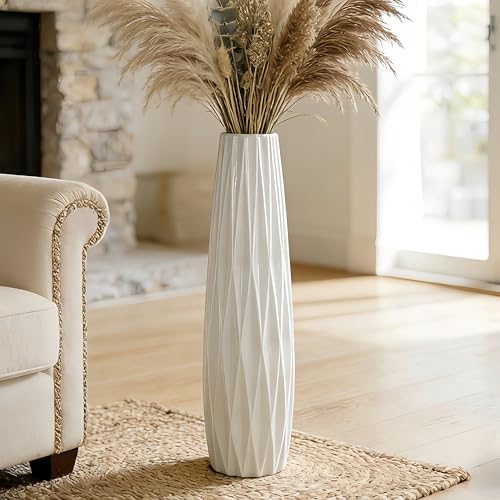
The GDSZJLJ vase is the ceramic pick, and its height is the argument. At 28 inches tall, it clears the line that separates a floor vase from an oversized tabletop vase, which is the trap this category is full of — plenty of vases sold as floor vases are really 17-inch table pieces wearing a taller name. This one is a genuine floor piece: it stands beside a sofa arm or in a corner, it holds a full bunch of pampas grass, and its white glaze with a ten-stripe pattern reads as modern farmhouse without trying to be anything else. The ceramic body is the heaviest material in this guide relative to its size, which gives it the low center of gravity that keeps a tall vase upright, and the glazed surface wipes clean with a damp cloth.
The honest limits are the ceramic limits. A 28-inch ceramic vase that falls will chip or break, so it belongs in a low-traffic corner rather than a hallway, and it should never be placed where a child can reach the top and pull. The listing data reviewed confirms the dimensions, the material and the floor mounting type, and the Amazon listing record behind this pick is about nine months old, so a glance at the live offer before posting is sensible. Within its brief — a tall white ceramic vase that anchors a corner at the budget tier — the specification is complete, and it is the guide’s default answer for a living room that needs one vertical line and nothing more.
Choose it if: you want a true 28-inch ceramic floor vase in white, and a corner that needs anchoring is the room you are furnishing.
Skip it if: you need a vase for a high-traffic hallway, you want a set rather than a single piece, or you plan to use fresh flowers with standing water.
2. Sziqiqi Large Black Vases Tall 27-Inch Set of 3 — Best Floor Vase Set

Specs
- Type: Set of 3 tall floor vases, metal
- Sizes: Largest about 26.8 x 7 in, with two smaller graduated pieces
- Opening: 4.72 in on the largest vase
- Material: Metal, black with a honeycomb texture
- Finish: Matte black
- Use: Dried flowers, pampas grass, decorative branches
- Tier: Mid-range
The Sziqiqi set is the grouping pick, and its graduated heights are the argument. Three black metal vases — the tallest about 27 inches, the other two stepping down — read as one arrangement on a hearth, along a long wall or flanking an entryway console, and they can be split across two rooms when the seasons change, which a single vase can never do. The honeycomb texture is the surface that makes the set work: a matte black finish with a hammered, three-dimensional pattern that catches light without shine, so the vases read as modern rather than industrial. The largest vase has a 4.72-inch opening, the widest mouth in this guide, which takes a full bunch of pampas grass without crowding.
The specification underneath the styling is the practical one. Metal is lighter than ceramic, so the set is easy to move and rearrange, and it will dent rather than shatter if it is knocked — the right trade for a household with pets or children. The cost of that lightness is stability: a metal vase is easier to tip than a ceramic one of the same height, so the set belongs against a wall or in a corner rather than in the middle of a traffic path, and the smallest piece is too short to stand on a floor on its own, so it belongs where the group can be seen together. The Amazon listing record behind this pick confirms the material, the set of three and the dimensions, with two listing crawls about seven and eight months old and a seller record showing the set shipped from Amazon. Bought for a long wall or a hearth where three heights in a row are the look, it is the most flexible pick in this guide.
Choose it if: you want three graduated heights in one purchase, a matte black metal finish, and a set you can rearrange or split across rooms.
Skip it if: you want a single statement vase, you need the heaviest and most stable piece available, or the smallest vase would end up standing alone in a corner.
3. Deco 79 Mother of Pearl Handmade Tall Mosaic Vase, 33-Inch — Best Statement Floor Vase

Specs
- Type: Tall floor vase, mother of pearl mosaic
- Size: 10.25 x 10.25 x 33.13 in
- Material: Mother of pearl shell mosaic with blue accents, over a wood-based body
- Color: Cream with blue accents
- Use: Decorative centerpiece, dried arrangements
- Tier: Premium
The Deco 79 vase is the statement pick, and its surface is the argument. Hand-laid pieces of mother of pearl shell form a mosaic with blue accents across a 33-inch body, so the vase catches light from across the room and changes as the light changes — the iridescent quality that printed patterns imitate and never quite match. At 10 inches square, it has the broadest body in this guide, which gives it a stable stance for its height and a mouth wide enough for a generous arrangement. It is the vase in this guide most likely to be bought as a gift, and the one most likely to be the first thing a visitor notices in the room.
The honest limits are the mosaic’s limits. A handmade mosaic varies slightly from piece to piece, which is a sign of genuine handwork rather than a flaw, but it means the exact pattern of shell pieces will not match the listing photograph tile for tile. The shell surface should be dusted rather than scrubbed, and the vase is a decorative piece — it is not built to hold standing water for fresh flowers. The Amazon listing record behind this pick confirms the material, the dimensions and the model, with a listing crawl about eight months old, so a glance at the live offer before posting is sensible. For a living room or entryway where one object is meant to carry the decor, the Deco 79 is the pick.
Choose it if: you want a handmade mother of pearl mosaic surface, a 33-inch statement piece, and a vase that holds a room on its own.
Skip it if: you want an exact match to a photograph, you need a vase for fresh flowers with water, or a matte finish suits the room better than a shimmering one.
4. LEEWADEE Large Floor Vase, 36-Inch Mango Wood, Golden — Best Wooden Floor Vase

Specs
- Type: Tall floor vase, handmade mango wood
- Size: About 7 x 7 x 34 in, per the product-information block; the listing title describes it as 36 inches tall
- Opening: 3.5 in
- Material: Mango wood, golden finish
- Use: Decorative branches and dried flowers only
- Tier: Mid-range
The LEEWADEE vase is the wooden pick, and its material is the argument. Handmade from mango wood with a golden finish, it brings a warmth that ceramic, metal and fiberglass cannot — the grain shows through the finish, the surface is smooth to the touch, and the whole object reads as a piece of craft rather than a piece of decor bought off a shelf. It is the tallest wooden vase in this guide, and its slim 7-inch footprint lets it stand in a narrow gap — beside a bookcase, between a sofa and a wall — where a 10-inch square vase would not fit. The 3.5-inch opening suits a few tall branches or a sparse pampas arrangement, which is a style choice as much as a limit: the vase is meant to frame a few stems, not to swallow a bunch.
The honest limits are two, and the guide prints them plainly. The first is the height figure: the listing title describes this vase as 36 inches tall, while the product-information block records 7 by 7 by 34 inches, so the true height is about 34 to 36 inches and should be confirmed on the live listing before ordering for a space with a tight ceiling or shelf clearance. The second is the verification route: the Amazon listing record behind this pick is about eleven months old, the oldest in this guide, so the live offer should be glanced at before posting. And the material rule is absolute — mango wood is a vessel for dried stems, not fresh flowers, and standing water should never go in it. Within its brief — a tall handmade wooden vase in gold for a narrow corner — it is the guide’s warmest pick.
Choose it if: you want a handmade mango wood vase, a slim footprint for a narrow gap, and a golden finish that warms a neutral room.
Skip it if: you need a published height figure confirmed before ordering, you want to use fresh flowers with water, or a wide opening for a full pampas bunch matters more than the wood.
5. Z Gallerie Accolade Vase, 48.75-Inch Gold Fiberglass — Best Extra-Tall Floor Vase

Specs
- Type: Extra-tall floor vase, fiberglass
- Size: 16.25 x 16.25 x 48.75 in
- Material: Fiberglass with a gold metallic finish
- Shape: Fluted, oblong
- Use: Decorative centerpiece, dried arrangements, entryway statement
- Tier: Premium
The Z Gallerie Accolade vase is the height pick, and its height is the whole argument. At 48.75 inches — just over four feet — it is nearly a foot taller than anything else in this guide, and it belongs in a room that can take that scale: a high-ceilinged living room, a wide entryway, a double-height space where a 28-inch vase would disappear. The fluted form is the design: vertical ribs run the full height of the vase, catching light down its length, and the gold metallic finish makes it read as a sculptural object rather than a container. Fiberglass is the material that makes this height practical — a ceramic vase this tall would be too heavy to move and too dangerous to fall, while this one can be repositioned by a single person.
The specification underneath the styling is the most generous footprint in the guide. At 16.25 inches square, the base is the widest here, which is the geometry that lets a four-foot vase stand without looking top-heavy, and the oblong fluted shape gives it a presence that a plain cylinder at the same height would not have. The honest limits are the scale limits: this vase will dominate a standard eight-foot-ceiling room, and it should never be placed where it blocks a sightline to a television or a window. The Amazon listing record behind this pick confirms the material, the dimensions and the model, with a listing crawl about seven months old. Bought for a space with the ceiling height to match it, the Accolade is the most dramatic pick in this guide.
Choose it if: your ceilings are high, you want a vase that reads as sculpture, and a gold fluted finish suits the room.
Skip it if: your ceilings are standard height, the vase would block a sightline, or a smaller, quieter piece suits the room better.
Before You Buy: Floor Vase Checks
Check the Recall Record for the Vase, Not the Category
A search of the federal recall record found no recall covering floor vases as a product class, and none covering any of the five picks or their makers. That is worth stating plainly, because the absence of a record is itself a finding — but it is not a reason to skip the check on a used vase, where the model and the date code on the base are the only way to confirm that a secondhand piece is not part of some other action. The adjacent records in this home decor family are worth naming with precise scope, because they are the ones a buyer might confuse with a vase recall. The Designs Direct three-light floor lamps recalled in October 2026 are a cord and wiring hazard in lamps, not vases. The Dania Furniture Hayden bookcase recalled in June 2024 is a tip-over hazard in tall furniture, not in a vase. Neither touches a pick in this guide, and neither should be read as a vase record.
Put the Vase Where It Cannot Fall
A floor vase is a tall, top-heavy object, and its stability is decided by the floor and the traffic around it, not by the vase alone. The GDSZJLJ ceramic vase and the LEEWADEE wood vase are the most stable by geometry, with their weight carried low; the Sziqiqi metal set is lighter and belongs against a wall; the Z Gallerie vase compensates for its light fiberglass body with the widest footprint in this guide. Every pick here should stand on a hard, level surface with its full footprint on the floor — never half on a rug edge — and out of the path where a child can reach it or a pet can knock it. A vase that falls from its place breaks its body, its stems and very often the floor beneath it, and the repair is rarely worth the cost. The practical rule is the furniture rule: the vase goes where it cannot be climbed, pulled or used as a handhold, and its stems are arranged with the vase held steady, not perched on a ladder.
Dried Stems Are the Honest Use
Most floor vases are bought for dried stems — pampas grass, faux eucalyptus, tall branches — and that is the honest use for four of the five picks here. Ceramic and metal vases can hold fresh flowers with water if the listing says they are watertight, but a buyer should check that claim on the live page before filling a vase, because a seam or an unglazed interior will leak onto a wood floor. Wood vases should never hold water at all, and the mosaic surface on the Deco 79 pick should be kept dry. A useful habit is to put a small waterproof liner inside any vase that will hold fresh stems, and to change the water and trim the stems regularly, because a vase that smells stale is a vase that will be emptied and never filled again.
Measure the Opening Against the Stems
A floor vase bought without measuring its opening is a vase that will either swallow a sparse arrangement or crowd a full one. The Sziqiqi set’s 4.72-inch opening takes a full bunch of pampas grass; the LEEWADEE vase’s 3.5-inch opening takes a few tall branches and forces a sparser look. Before ordering, count the stems you plan to use and measure the bunch at its widest point, then buy the opening that fits them with a little room to spare. A bunch that is squeezed into a narrow neck will splay and shed; a few stems in a wide mouth will lean and look lost. The opening is a specification, not a detail.
Frequently Asked Questions
How tall should a floor vase be for a living room?
Between 24 and 36 inches tall suits a standard living room with eight-foot ceilings, standing beside a sofa or in a corner without competing with wall art or windows. The GDSZJLJ vase at 28 inches, the Sziqiqi set at 27 inches at its tallest, the Deco 79 at 33 inches and the LEEWADEE at about 34 to 36 inches all sit in that range. The Z Gallerie Accolade vase at nearly 49 inches is a different proposition, built for high ceilings and wide entryways where its scale is the point.
Can floor vases hold fresh flowers with water?
Some can, and some should never be filled. Ceramic and metal vases can hold fresh flowers if the listing says they are watertight, and a waterproof liner inside is a sensible precaution on a wood floor. Wood vases, like the LEEWADEE pick, should never hold standing water. The Deco 79 mosaic vase is a decorative piece and should be kept dry. Dried stems — pampas grass, faux eucalyptus, tall branches — are the honest use for most floor vases, and they need no water at all.
Will a tall floor vase tip over easily?
It depends on the base, the weight and where it stands. A vase with a wide base and a low center of gravity, like the GDSZJLJ ceramic vase, is the most stable by geometry. A lighter metal vase belongs against a wall or in a corner rather than in a traffic path. The Z Gallerie vase compensates for its light fiberglass body with the widest footprint in this guide, at 16.25 inches square. Whatever the material, a floor vase should stand on a hard, level surface with its full footprint on the floor, out of the path where a child can reach it or a pet can knock it.
Do I need to anchor a floor vase to the wall?
Most floor vases do not need anchoring, because they are light enough to move and heavy enough to stand on their own — but a very tall vase in a household with small children or large pets deserves a second thought. Museum putty under the base, a felt pad that keeps the vase from sliding on a hard floor, or simply placing the vase in a corner where two walls support it are all practical answers. If a vase is ever used as a handhold by a child, move it to a room the child does not play in.
Conclusion
A floor vase is bought on its job before it is bought on its looks, and the right one is the vase whose height, material and footprint match the floor it will actually stand on. For a living room corner that needs one vertical line, the GDSZJLJ ceramic vase is the guide’s default — a true 28-inch floor piece in white at the budget tier. The Sziqiqi set is the flexible answer, three graduated black metal vases for a long wall or a hearth, with the widest opening in the guide. The Deco 79 mother of pearl mosaic vase is the statement piece, a 33-inch handmade surface that catches light from across the room. The LEEWADEE mango wood vase is the warmest pick, a tall golden piece for a narrow gap, with the single caution that its height figure should be confirmed on the live listing. And the Z Gallerie Accolade vase is the dramatic answer, nearly four feet of fluted gold fiberglass for a room with the ceiling height to match it. Measure the ceiling, match the material to the traffic, and any of the five will hold its corner properly for years.