Key takeaways
- The best thermal insulated curtains, compared by construction, header and length: lined blackout pairs, triple-weave panels and a budget rod-pocket set.
For most rooms, the right thermal insulated curtain is a full-coverage blackout panel that hangs close to the wall, pools or just kisses the floor, and puts real fabric mass between the glass and the room: the insulation is not a coating or a gadget, it is the still air the panel traps and the radiant heat its dense face reflects back. Thermal curtains split into three constructions, and the construction matters more than the color chart. Triple-weave panels weave a dark core yarn into the fabric itself, so the insulation is the cloth — nothing to peel, crack, or delaminate. Lined curtains sew or bond a separate blackout and thermal lining behind a face fabric, which blocks more light and buffers more heat but adds weight and a second layer to wash. Foam- and film-backed legacy panels take a third route and are now the minority. This guide compares five thermal insulated curtains across the two constructions that dominate the category today — two lined total-blackout pairs, two triple-weave pairs, and a dual-pocket budget set — with the sizes, headers, and care details that decide how a panel actually performs on a cold window in January and a west-facing one in August.
As an Amazon Associate, we earn from qualifying purchases.
Table of Contents
- Why Thermal Insulation Changes the Curtain Decision
- How to Choose the Right Thermal Curtain
- Quick Comparison
- 1. Sun Zero Nordic Theater Grade Extreme Blackout Curtain Panels
- 2. ChrisDowa 100 Percent Blackout Curtains with Black Liner
- 3. H.Versailtex Back Tab Blackout Curtains
- 4. LEMOMO Thermal Blackout Curtains
- 5. DWCN Blackout Curtains
- Before You Buy: Thermal Curtain Checks
- Frequently Asked Questions
- Conclusion
Why Thermal Insulation Changes the Curtain Decision
A decorative curtain is chosen by how it looks at noon. A thermal curtain earns its place at the two moments looks do not matter: the winter night when the glass radiates cold into the room, and the summer afternoon when a sun-struck window turns into a radiator running in reverse. Windows are the weakest insulation in most walls, and a heavy panel hung correctly works on the problem three ways at once — it slows conductive heat flow with fabric mass, it traps a layer of still air between cloth and glass, and its dense or lined face reflects radiant energy back toward the side it came from. No curtain turns a single-pane window into a wall, and maker percentages should be read as laboratory ceilings rather than room guarantees, but the difference between a sheer and a lined blackout panel over the same glass is the difference between a decoration and a working part of the room’s heating and cooling system.
The Construction Is the Insulation
Triple-weave fabric is woven on a loom with a black core yarn sandwiched between two faces of colored yarn. The dark core is what blocks light, and the density of the weave is what slows air and heat. Because the blocking layer is structural, a triple-weave panel stays flexible, drapes like ordinary cloth, and can be machine washed without any coating to damage. Its ceiling is set by physics: a single layer of woven fabric, however dense, passes a little light at the weave’s pores in pale colors and cannot match a true liner for darkness.
A lined curtain takes the opposite approach. A face fabric — sometimes textured, sometimes printed — is paired with a separate blackout lining, and the maker’s thermal claim rests on the combined assembly: two layers, an air gap between them, and a lining engineered to reflect heat. The best of these are the only curtains that honestly deliver total blackout in light colors, and they are the strongest thermal performers in this guide. The costs are weight, stiffness, price tier, and care: a lined panel is a heavier object on the rod and in the wash.
Coverage Beats Fabric
The most common reason a good thermal curtain disappoints is that it was hung like a decoration. A panel that stops at the sill leaves the coldest glass exposed at the bottom; a panel mounted inside the frame leaks around all four edges; a panel that barely spans the window stretched flat has no folds, and the folds are where much of the air-trapping happens. Makers across this category repeat the same guidance: buy enough width for the panels to gather at one and a half to two times the window’s width, mount the rod above and beyond the frame so the fabric overlaps the wall, and choose a length that reaches the floor or at least well past the sill. A mid-range panel hung with full coverage will outperform a premium panel hung skimpy, which is why this guide lists exact sizes and treats the 120 inch extra-long pick and the 63 inch short-window pick as different tools rather than better and worse versions of one tool.
Darkness and Insulation Are Related, Not Identical
Listings blur two claims that buyers should hold apart. Light blocking is about the face: how much visible light passes through the fabric. Thermal insulation is about the assembly: fabric mass, trapped air, and how completely the window is covered. They correlate — the dense weaves and liners that stop light also slow heat — but they are not the same measurement, and a curtain can be an honest total blackout while offering modest insulation if it is thin, just as a heavy triple-weave in a dark color insulates well while passing a faint glow at noon. Read each pick below for both numbers where the maker publishes them, and be suspicious of any listing that gives one figure and lets you assume the other.
How to Choose the Right Thermal Curtain
Pick the Construction for Your Window’s Problem
If the window’s problem is heat — a west-facing living room, a bedroom over a garage, an old house with single-pane glass — start with the lined picks. A sewn or bonded thermal lining is the strongest buffer in this guide, and the Sun Zero Nordic’s laboratory-tested lining is the category’s benchmark claim. If the problem is mostly light with a side of draft — a street-lit bedroom, a nursery nap — a lined black-liner panel like the ChrisDowa delivers total darkness, and its two thick layers insulate as a by-product. If the window is ordinary and the goal is a general upgrade over sheers or tired panels, triple-weave is the balanced answer: real insulation, real darkening, the easiest care in the category, and no liner to worry about in the wash.
Match the Header to How You Live With the Window
Grommet tops slide. That single fact decides most header choices: a grommet panel glides open every morning and closed every night with one hand, which is exactly the rhythm thermal curtains ask for, because an insulating panel only insulates while it is closed. Back tabs hide the rod and hang in tailored, stationary folds — the tailored look in this guide — but they drag more on the rod and suit windows that stay dressed. Rod pockets are the stillest header of all: the fabric bunches on the rod, opening and closing is a deliberate act, and the look is traditional and gathered. The DWCN set below hedges with two pocket sizes on one panel. Choose the header by the window’s daily routine, not by the photograph.
Size by the Glass, Then by the Rod
Measure the glass, then add. For thermal work, the panel pair should overlap the frame on both sides and reach from above the frame to the floor or deep past the sill; the standard 52 x 84 inch pair in this guide covers a typical bedroom window with that overlap, the 42 x 63 inch DWCN pair is sized for shorter windows where an 84 inch panel would puddle, and the Sun Zero Nordic’s 120 inch length exists for tall windows and high ceilings where standard drops simply run out. Width is the figure buyers shortchange: two 52 inch panels give 104 inches of fabric, which gathers correctly over a window up to roughly 60 to 70 inches wide once overlap is counted. Beyond that, the honest fix is a second pair, not a stretched one.
Read the Care Line Before the Color Chart
Every pick in this guide is machine washable per its maker, which is part of why they are here — a thermal curtain over a kitchen-adjacent or street-facing window collects dust and cooking film, and a panel that cannot be washed becomes a permanent filter. The details differ. Lined panels wash as a unit and dry heavier; the ChrisDowa listing specifies a gentle cycle below 86 degrees Fahrenheit and low tumble drying. Triple-weave panels wash like ordinary polyester cloth. All of them forbid bleach. A lined panel that must be washed often is a chore; a triple-weave panel in a dusty room is a load of laundry. Match the construction to the room’s dirt as well as its sun.
Quick Comparison
| Product | Construction | Size | Best For |
|---|---|---|---|
| Sun Zero Nordic Theater Grade Extreme Blackout Curtain Panels | Lined, thermal extreme lining | 52 x 120 in, 2 panels | Tall windows and the strongest thermal claim |
| ChrisDowa 100 Percent Blackout Curtains with Black Liner | Two layers with black liner | 52 x 84 in, 2 panels | Total darkness in a standard bedroom size |
| H.Versailtex Back Tab Blackout Curtains | Triple weave, dual header | 52 x 84 in, 2 panels | A tailored look that hides the rod |
| LEMOMO Thermal Blackout Curtains | Triple weave | 52 x 84 in, 2 panels | Full-length coverage in a deep color range |
| DWCN Blackout Curtains | Triple weave, dual rod pockets | 42 x 63 in, 2 panels | Short windows on a budget |
1. Sun Zero Nordic Theater Grade Extreme Blackout Curtain Panels — Best Lined Thermal Curtain

Specs
- Type: Lined blackout curtain panels with thermal extreme lining
- Size: 52 x 120 in per panel, 2 panels
- Material: Polyester, per the maker’s listing data
- Header: Grommet top, fits rods up to 1.5 in in diameter
- Light blocking: Total blackout, laboratory tested by the maker
- Thermal claim: Maker’s laboratory testing reports reduced energy loss through windows of up to 50 percent
- Noise claim: Maker’s laboratory testing reports outside noise reduction of up to 45 percent
- Sun protection: UPF 50 plus, per the maker
- Color: White
- Tier: Premium
Sun Zero is the legacy name in this category — a brand built entirely on blackout and thermal panels — and the Nordic is its theater-grade line: a face fabric bonded to the maker’s Extreme Blackout thermal lining, sold here as a pair of 52 x 120 inch panels in White. The 120 inch drop is the headline dimension. Tall windows, two-story foyers, and bedrooms with nine- or ten-foot ceilings are exactly where standard 84 and 96 inch panels fail the coverage rule, ending above the floor and venting the trapped air layer at the bottom. The Nordic simply reaches, and a thermal panel that reaches the floor is doing a different job from one that stops six inches short.
The performance claims are the strongest in this guide, and they are framed the right way: the maker attributes them to third-party laboratory testing rather than to adjectives. Total light blockage, outside noise reduced by up to 45 percent, and energy lost through the window decreased by up to 50 percent are the published figures, and the honest reading is that they describe the lining’s performance under test conditions — a real room with edges, gaps, and a rod will land below them. Even read conservatively, a bonded thermal lining is the heaviest artillery in the category, and this is the pick for the window that is a genuine heating and cooling problem rather than a decorating one.
The trade-offs are the lined construction’s trade-offs. A bonded pair at this length is heavy on the rod, wants a properly anchored rod rather than a tension mount, and washes as a substantial load. White is the demanding color choice: it shows dust and street film sooner than the deep colors elsewhere in this guide, and a white lined panel over a dirty window gives up some of the darkness a dark face would add for free. Buyers with standard-height windows should also note that the Nordic line is sold in shorter drops on other listings; this pair is the extra-long configuration, chosen for the rooms the rest of the guide cannot cover.
Choose it if: your windows are tall, your heating or cooling bill has a window-shaped problem, and you want the strongest published thermal claim in the category.
Skip it if: your windows are standard height, your rod is a light tension mount, or you want the easy wash-and-hang care of an unlined panel.
2. ChrisDowa 100 Percent Blackout Curtains with Black Liner — Best Total Blackout

Specs
- Type: Two-layer blackout curtain panels with black liner
- Size: 52 x 84 in per panel, 2 panels
- Material: Microfiber face with a black blackout liner, per the maker
- Header: Grommet top, metal grommets
- Light blocking: Total blackout, per the maker — the black liner blocks light the face color cannot
- Thermal: Insulated by the two-layer assembly, per the maker
- Care: Machine wash below 86 degrees Fahrenheit on a gentle cycle; do not bleach; tumble dry low; warm iron if needed, per the maker
- Color: Black
- Tier: Premium
Most blackout curtains ask the face fabric to do the blocking, which is why pale panels so often disappoint: a triple weave in ivory is a filter, not a shutter. The ChrisDowa design removes the color from the equation by sewing the block into a black liner behind a microfiber face — two thick layers, in the maker’s description — so the panel delivers total blackout in the literal sense the listing claims, whatever the face shows the room. This pair is the Black configuration at the standard 52 x 84 inch bedroom size, the configuration where the claim is easiest to keep: a dark face over a black liner over a standard window is as close to a sealed shutter as fabric gets.
The thermal story follows from the same assembly. Two layers trap more still air than one, and the liner that stops light also slows radiant exchange, so the panel insulates as a structural by-product rather than as a separate feature. The maker’s listing pairs the blackout claim with noise reduction and thermal insulation, and the two-layer build is the credible reason for both. For shift workers, light-sensitive sleepers, and anyone whose bedroom faces a streetlight, this is the guide’s darkness-first pick, and the standard size keeps it on ordinary rods and in ordinary washing machines.
The honest limits are weight and care discipline. A lined 84 inch pair is the heaviest wash load in this guide after the Sun Zero, and the maker’s care line is specific — gentle cycle, cool water below 86 degrees Fahrenheit, low tumble — because heat is what ages a bonded and sewn liner assembly. The black face is also a commitment: it is the right answer for a media room or a sleep-first bedroom and a heavy note in a small, pale living room, where the same construction in one of the line’s lighter face colors would serve better. And as with every total-blackout claim, the fabric can only block what it covers — the checks section’s mounting advice decides whether the room goes fully dark.
Choose it if: total darkness is the first requirement — for sleep, for a media room, for a nursery — and you want it at the standard 84 inch size.
Skip it if: you want a pale, airy look, the lightest possible wash load, or a panel you can launder hot without thinking.
3. H.Versailtex Back Tab Blackout Curtains — Best Tailored Header

Specs
- Type: Triple-weave blackout curtain panels
- Size: 52 x 84 in per panel, 2 panels
- Material: Polyester blend microfiber, per the maker
- Header: Back tab and rod pocket dual header — back loops plus a pocket, per the maker
- Light blocking: Blocks up to 99 percent of light, per the maker’s listing data for the line
- Thermal: Thermal insulated triple weave, per the maker — energy saving, temperature balancing, UV protection listed
- Care: Machine washable, per the maker
- Color: Bluish Gray
- Tier: Mid-range
Every other pick in this guide hangs from a grommet or a pocket. The H.Versailtex pair hangs from loops sewn behind the top hem — back tabs — with a rod pocket built in as the second option, and that header is the whole point of the pick. A back-tab panel hides the rod entirely and falls in the deep, even folds of a tailored drape, which is the look of custom window treatments at a ready-made tier. In Bluish Gray at 52 x 84 inches, this is the curtain for the living room or dining room where the window treatment is part of the furniture, and where exposed grommet rings would read as hardware rather than decor.
The fabric underneath the tailoring is the maker’s long-running triple weave: a polyester blend microfiber with the dark core yarn that gives the line its blackout claim — up to 99 percent of light in the maker’s listing data — and its thermal insulation. The listing data for the line is unusually complete on the thermal side, naming energy saving, temperature balancing, UV protection, privacy, and noise reduction among its features, and the construction earns the modest version of all of them: a dense single-layer panel that darkens a room properly, takes the edge off a drafty window, and washes without a liner to protect. It will not seal a room like the ChrisDowa’s black liner, and it does not pretend to.
The compromise is motion. Back tabs drag on a rod in a way grommets do not; these panels open and close with a deliberate pull, and on a window that is worked twice a day, every day, the friction is a daily tax. The dual header softens the verdict — the same panels can go up on the rod pocket for a gathered, stationary look — but neither option glides. Buy this pair for windows that are dressed once and adjusted occasionally, in rooms where how the curtain hangs matters as much as what it blocks, and let the grommet picks serve the bedroom windows on a daily open-close rhythm.
Choose it if: you want the hidden-rod, tailored-fold look of custom drapes, with real blackout and insulation behind it.
Skip it if: the window opens and closes daily and you want one-handed glide, or you need a liner’s total blackout.
4. LEMOMO Thermal Blackout Curtains — Best Full-Length Triple Weave

Specs
- Type: Triple-weave thermal blackout curtain panels
- Size: 52 x 84 in per panel, 2 panels
- Material: Polyester, per the maker
- Header: Grommet top, metal grommets
- Light blocking: Blocks 85 to 99 percent of light depending on color, per the maker — darker colors block more
- Thermal: Thermal insulated triple weave, per the maker
- Care: Machine washable, per the maker
- Color: Sea Teal
- Tier: Mid-range
LEMOMO’s thermal blackout line is the straightforward center of this category: a triple-weave polyester panel, a grommet top, the standard 52 x 84 inch size, and a color range deep enough that the color itself becomes a specification. This pair is Sea Teal, chosen deliberately. The maker publishes its light blocking as a range — 85 to 99 percent — and states plainly that darker colors block more, which makes the deep end of the color chart the functional end. A saturated teal sits near the top of what a single woven layer can do, while giving a room more life than the black and charcoal panels that anchor the budget end of the category.
As a thermal panel, the LEMOMO is the balanced case this guide keeps returning to. The triple weave’s density slows heat and air through the fabric, the grommets make the daily open-close rhythm effortless, and the absence of a liner keeps the pair light on the rod and simple in the wash — the construction a buyer can live with for years without a care routine. What it will not do is match the lined picks at their specialties: held against bright sun, a single woven layer in any color passes a faint lightening at the fabric that a black liner eliminates, and its insulation is the fabric’s own rather than a two-layer assembly’s.
That makes the pick a matter of honest priorities. For the large middle of real windows — a living room that runs warm in the afternoon, a guest room that faces the street, a home office that needs glare gone and the temperature steadied — the LEMOMO’s combination of full standard size, deep-color blocking, easy glide, and easy care is the category’s sensible default. Buyers should simply choose their color from the dark half of the chart and treat the pale colors in the line as room-darkening rather than blackout panels, exactly as the maker’s own range admits.
Choose it if: you want the balanced triple-weave package — real darkening, real insulation, easy care — in a color with some presence.
Skip it if: you need guaranteed total blackout for sleep, or your window’s heat problem calls for a lined panel.
5. DWCN Blackout Curtains — Best Budget Rod Pocket
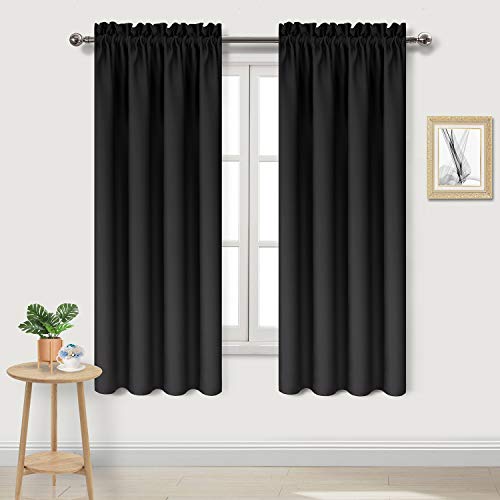
Specs
- Type: Triple-weave blackout curtain panels
- Size: 42 x 63 in per panel, 2 panels
- Material: Polyester, per the maker — 100 percent polyester fabric
- Header: Dual rod pockets — one pocket of 1 in and one of 2 in diameter, per the maker’s listing data
- Light blocking: Blocks 90 to 99 percent of sunlight, per the maker — dark colors block more
- Thermal: Thermal insulated, energy saving and noise reducing, per the maker
- Care: Machine wash cold on a gentle cycle; do not bleach; low iron if needed, per listing data for the line
- Color: Black
- Tier: Budget
The DWCN pair is the budget pick, and it earns the place on specifics rather than on price alone. The size is the first: 42 x 63 inches is the short-window format that the 84 inch pairs in this guide cannot serve — the bedroom window over a radiator, the basement window, the kitchen window over a sink — where a long panel would puddle on a sill or a heater. The second specific is the header. Where most rod-pocket panels offer one pocket, the DWCN listing describes two, a 1 inch and a 2 inch pocket on the same panel, so the pair fits slim cafe rods and standard rods alike without a style change — a small, genuinely useful piece of design at this tier.
The fabric is the category’s standard recipe done completely: a triple-weave polyester that the maker rates at 90 to 99 percent light blocking in dark colors, with thermal insulation and noise reduction listed alongside, and this Black configuration sits at the top of its own range. Around a short window, a black triple-weave pair hung with overlap is a serious darkening and insulating tool, and the rod pocket’s gathered, stationary hang suits windows that are dressed and left — the pocket’s bunching seals the top edge against the light leak that a grommet’s open rings can allow.
The limits are the format’s limits. Sixty-three inches is a length with no forgiveness: on a standard window it ends mid-wall, which is why this pair is a specialist rather than the guide’s default. The rod pocket also gives up the daily glide — these panels are adjusted, not drawn — and the maker’s percentages, as everywhere in this category, describe the fabric rather than the installation. Buy the DWCN for the short window it was sized for, in the dark color that keeps its claim, and it returns more function per panel than anything else at its tier.
Choose it if: your window is short, your rod is already up, and you want blackout and insulation at a budget tier without leftover length to hem.
Skip it if: your window needs an 84 inch or longer drop, or you open and close the panels every day.
Before You Buy: Thermal Curtain Checks
Mount for Coverage, Not for the Photograph
Thermal performance is decided at the rod. Mount the rod high enough and wide enough that the closed panels overlap the wall on both sides and cover the frame’s top edge; a panel that ends inside the frame’s outline leaks light and air at every edge no matter what its fabric blocks. Outside-mount hanging with a floor-length drop turns the panel and the wall into a shallow insulating pocket. Inside-mount hanging looks tidy and performs measurably worse. If the room must go fully dark — the ChrisDowa’s job — consider the light that enters above the rod as well; a rod mounted close to the ceiling, or a valance over the top, closes the last gap.
Treat Maker Percentages as Ceilings
Every number in this guide is a maker’s figure, and the honest ones are framed as ranges or laboratory results. The Sun Zero Nordic’s energy and noise figures come from the maker’s third-party laboratory testing; the triple-weave brands publish light-blocking ranges that move with color. None of them describes your window, your rod, or your gaps. Use the figures to compare constructions — lined ahead of triple weave, dark ahead of pale — and expect the room result to be a clear improvement rather than a laboratory repeat. A listing that promises a single round number with no range and no test basis is telling you about its marketing, not its fabric.
Check the Rod Before the Panels Arrive
Lined panels are heavy, and the extra-long Sun Zero pair is the heaviest hang in this guide. A rod anchored into studs or proper wall anchors carries them; a tension rod inside the frame may not, and it forces the inside-mount coverage compromise at the same time. Check the rod’s diameter against the header: grommets in this guide fit rods up to 1.5 inches, the H.Versailtex back tabs want a rod slim enough to thread through sewn loops, and the DWCN’s dual pockets accept rods up to 2 inches. A mismatch discovered after the panels arrive is the most common and most avoidable failure in the category.
Cord Safety Belongs to a Different Product Class
The window-covering recalls of the last two years — corded roller shades and zebra blinds, including the 2025 recalls of LINKCOO blackout roller shades and Persilux zebra blinds — concern blinds and shades with operating cords, which federal rules have required to be cordless in stock products since December 2022. Fabric curtain panels of the kind in this guide have no operating cords at all: they hang from a rod and move by hand. None of the five picks is a blind or shade, none carries a cord, and none is subject to those recalls. The distinction matters when shopping the wider category — the moment a listing adds a cord, a chain loop, or a motorized wand, it has left the curtain class and entered the one the recalls govern.
Wash One Panel First
Lined and bonded panels should meet water carefully the first time: a gentle cold cycle, no bleach, and the maker’s drying instruction followed exactly — the ChrisDowa’s below-86-degrees wash and low tumble are typical of the lined class. Triple-weave panels are more forgiving but still darken best when washed with like colors. If a pair will be washed often, confirm the routine against the room: a street-facing living room panel may wash monthly, and the construction that survives that rhythm in your machines is the right one, whatever its laboratory figures say.
Frequently Asked Questions
Do thermal insulated curtains actually lower heating and cooling costs?
They reduce the heat that moves through the window they cover, and windows are usually the least insulated part of a room’s walls, so a heavy, full-coverage panel makes a real difference to comfort near the glass and a modest difference to the room’s overall energy use. The size of the effect depends on the window — single-pane and poorly sealed windows gain the most — and on coverage: a lined panel hung with overlap and floor length performs far better than the same fabric hung inside the frame. Makers publish laboratory figures, such as the Sun Zero Nordic’s tested reduction in energy loss, but those are ceilings measured under controlled conditions. Treat thermal curtains as one effective layer in a drafty room’s defense, alongside sealed frames and sound windows, not as a substitute for either.
Which blocks more light, a triple-weave curtain or a lined curtain?
A lined curtain, and the gap is largest in light colors. A triple weave blocks light with a dark core yarn woven into the fabric, which is why its makers publish a range — the LEMOMO line states 85 to 99 percent depending on color, and the H.Versailtex line states up to 99 percent — with pale colors at the bottom of the range. A black liner behind the face, as in the ChrisDowa pair, does not care what color the face is: the liner blocks the light, so total blackout is achievable in any face color. If the room must go fully dark at noon, choose a liner. If strong darkening with easier care is enough, a dark triple weave is the simpler panel to own.
What size thermal curtains should I buy for a standard bedroom window?
Start from coverage, not from the glass alone. The pair should overlap the frame on both sides and hang from above the frame to the floor or well past the sill, and the combined fabric width should be one and a half to two times the window’s width so the panels gather in folds rather than stretching flat. For a typical bedroom window, the standard 52 x 84 inch pair used by three picks in this guide meets that math for windows up to roughly 60 to 70 inches wide. Shorter windows are better served by the DWCN’s 42 x 63 inch pair than by hemming a long panel, and tall windows need the Sun Zero Nordic’s 120 inch drop or a similar extra-long listing.
Can thermal insulated curtains be machine washed?
Yes — every pick in this guide is machine washable per its maker, which is one reason they were chosen. The care discipline differs by construction. Lined panels such as the ChrisDowa specify a gentle cycle in cool water below 86 degrees Fahrenheit, no bleach, and low tumble drying, because heat and agitation age the liner assembly. Triple-weave panels wash like ordinary polyester cloth on a gentle cycle. Wash lined pairs as a matched load, follow the drying instruction rather than improvising a hotter one, and expect a lined 84 inch pair to be a heavy wet load — if your machine is small, that alone may argue for the triple-weave picks.
Conclusion
A thermal insulated curtain is a working part of the room, and the right one is chosen by construction, coverage, and header before it is chosen by color. For the window that is a genuine energy problem — tall glass, hard sun, winter drafts — the Sun Zero Nordic’s lined, laboratory-tested construction at a 120 inch drop is the strongest tool in this guide. For total darkness at the standard bedroom size, the ChrisDowa’s black liner removes the face color from the blackout equation entirely. The H.Versailtex pair is the tailored choice, hiding its rod behind back tabs while its triple weave darkens and insulates behind the folds; the LEMOMO is the balanced triple-weave default, at its best in the deep colors its own maker rates highest; and the DWCN proves the budget tier can be specific rather than flimsy, sized and pocketed for the short windows the rest of the category forgets. Measure the glass, mount for overlap, pick the construction your window’s problem actually calls for, and the panels will keep doing their quiet work long after the color has become simply part of the room.