Our Short List of 3

- Best for: owners who want a premium pure-lead AGM pair and a high cranking rating, but who do not need the maximum specification in this comparison.
- Best for: owners who want a full AGM pair with strong capacity and reserve figures, and who will verify dimensions and terminal layout before ordering.

- Best for: owners who prefer an established national brand, want a slightly lighter Group 65 AGM to install, and are replacing both batteries together.
All 3 Picks at a Glance
| Product | Specs | Action |
|---|---|---|
| 2. Interstate Batteries MTZ Group 65 — pure-lead AGM for heavy use |
| Check price on Amazon |
| 3. Weize Platinum AGM Group 65 — strong reserve, mainstream specification |
| Check price on Amazon |
| 4. Interstate Batteries MTX Group 65 — AGM pick for long service life |
| Check price on Amazon |
Key takeaways
- Best batteries for the Ford 6.9L IDI diesel: Group 65 AGM picks compared by CCA, reserve capacity and fit, with dual-battery pairing and cold-start advice.
As an Amazon Associate we earn from qualifying purchases.
Affiliate Disclosure: This article contains affiliate links. If you buy through a link on this page, we may earn a commission at no extra cost to you. We base these picks on manufacturer specifications and published listing data, not on detailed research.
What “6 9 idi” means in this guide
The keyword behind this guide is written as “6 9 idi,” and in this article that is read as the Ford 6.9L IDI diesel engine. IDI stands for indirect injection, the combustion design Ford used on the 6.9-litre V8 diesel fitted to F-Series trucks in the 1980s. That reading matters because it changes the battery completely. A 6.9L IDI is not a small petrol engine that turns over easily on a modest battery. It is a high-compression diesel with glow plugs, a heavy starter motor, and, in factory form, two 12-volt batteries wired in parallel. Every pick below is therefore a full-size automotive starting battery in the size these trucks normally use, not a motorcycle battery, not a deep-cycle house battery for a camper, and not a lithium jump pack.
If your truck is actually a different engine, stop here and check the label on your current battery first. The guidance below only applies to the 6.9L IDI and to trucks that take the same battery group.
Why the 6.9L IDI is hard on batteries
A diesel starts by compression, not by a spark. The 6.9L IDI has to spin fast enough, while the glow plugs are also drawing current, for the fuel to ignite. On a cold morning both demands peak at the same time: the oil is thick, the starter needs more torque, the glow plug cycle runs longer, and the chemical reaction inside a lead-acid battery slows down, so the battery can deliver less of its rated power exactly when the truck needs more of it.
That is why cold cranking amps, usually shortened to CCA, is the headline number for this engine. CCA is measured at a very low temperature and describes how much current a battery can deliver for a short cranking burst. Reserve capacity is the second number to watch. It describes, in minutes, how long a fully charged battery can carry a moderate electrical load before its voltage falls too low. Reserve does not start the truck, but it tells you something useful about the size of the energy store behind the cranking rating, and it matters on a truck that may sit, run lights and accessories, or need repeated glow and crank attempts in winter.
The dual-battery layout is the third factor, and owners sometimes misunderstand it. Two batteries in parallel keep the system at 12 volts. They do not make a 24-volt system. What the pair does is share the cranking load and provide more total capacity. That sharing only works properly when the two batteries are a matched pair: same group size, same type, same age, and ideally the same model. Fitting one strong new battery next to a tired old one is a false economy, because the weaker battery drags the pair down and the stronger battery works harder to compensate. For a 6.9L IDI, budget and plan for a pair, and treat every price, weight and dimension in this guide as per single battery.
The fitment that matters: Group 65
Most Ford diesel trucks of this era use BCI Group 65 batteries. Group 65 defines the case footprint, the height, and the terminal layout, so a battery in this group should sit in the tray, accept the hold-down, and line up with the cables without stretching or re-routing them. Before you order, confirm four things on your own truck: the group size printed on the old battery, the terminal orientation, the tray and hold-down condition, and the cable length. Trays corrode, hold-downs go missing, and previous owners sometimes fit a near-size battery with an adapter or a shortened cable. A correct Group 65 battery cannot fix a broken tray.
Our picks at a glance
All four picks are Group 65, 12-volt AGM automotive batteries. AGM means the electrolyte is held in absorbed glass mat separators. Compared with a conventional flooded battery, an AGM battery is sealed, does not need watering, is more resistant to vibration, and generally accepts charge well, which suits an older truck that may be used hard and then parked for stretches.
- Odyssey ODX-AGM65 Extreme Series — the strongest cranking pick on paper, for cold climates and tired starters.
- Interstate Batteries MTZ Group 65 — a pure-lead AGM pick with a high cranking rating for heavy use.
- Weize Platinum AGM Group 65 — a mainstream AGM specification with strong reserve capacity.
- Interstate Batteries MTX Group 65 — an AGM pick aimed at long service life in demanding use.
Specifications below are taken from manufacturer and listing data for each model. Listings can change a revision or a rating, so confirm the label and the listing for the exact unit that will ship before you buy a pair.
1. Odyssey ODX-AGM65 Extreme Series — strongest cranking pick
ASIN: B091GV65V7
The Odyssey ODX-AGM65, also identified with the 65-PC1750 designation, is the heavy-duty option in this group. Odyssey describes this line as an Extreme Series AGM battery using thin plate pure lead construction. The manufacturer data sheet for the ODX-AGM65 lists 950 cold cranking amps, 145 minutes of reserve capacity and a 74 amp-hour rating at the 20-hour rate, in a Group 65 case with SAE automotive posts. Some retail listings show slightly lower figures for earlier revisions of this model, so match the data sheet to the exact unit offered rather than assuming every listing describes the same revision.
For a 6.9L IDI, that specification is attractive for a simple reason: cranking headroom. An engine that is older, that lives outside in winter, or that has a starter that is no longer at its best will use headroom quickly. A pair of these batteries shares a very large cranking capability, and the reserve figure is also the strongest in this comparison, which is useful if the truck runs accessories or needs several starting attempts with glow cycles between them.
There are trade-offs. This is a heavy battery, listed by the manufacturer at about 54 pounds, and you need two of them, so installation is a two-person or hoist-assisted job if you want to protect your back and the truck’s fenders. It is also a premium product in its class, so it makes the most sense where cold starts are genuinely difficult or where the truck must start reliably for work. Check the post layout and the case dimensions against your trays, and confirm which revision and rating the seller will supply before ordering a matched pair.
Best for: owners in cold regions, trucks that work for a living, and anyone replacing a pair on a truck that has become a slow, reluctant starter in winter.
2. Interstate Batteries MTZ Group 65 — pure-lead AGM for heavy use
- Best for: owners who want a premium pure-lead AGM pair and a high cranking rating, but who do not need the maximum specification in this comparison.
owners who want a premium pure-lead AGM pair and a high cranking rating, but who do not need the maximum specification in this comparison.
The Interstate MTZ Group 65 is listed as a 12-volt, 65 amp-hour pure-lead AGM automotive battery with an 800 CCA rating. That puts its cranking rating below the Odyssey on paper but still well into the range a diesel owner should be looking at, and ahead of the 750 CCA picks below. Interstate positions the MTZ line for high-demand vehicles, and the pure-lead AGM construction is the same broad approach used by other premium starting batteries: more active material in the case, sealed construction, and no routine watering.
In practice, this is the pick to consider if you want a step up from a standard AGM without going to the strongest and heaviest option in the group. A pair gives the truck a substantial combined cranking capability while keeping each individual battery a little more manageable to lift and fit. As with the Odyssey, do not mix one MTZ with an older battery of a different type on the other side of the engine bay. The pair should match.
Before buying, confirm the reserve capacity and the warranty terms on the current listing, because those details were less consistently published for this model in the sources checked than its CCA and capacity. Also confirm terminal orientation. Group 65 should be standardised, but a quick check against a photograph of your current installation costs nothing and prevents a cable-stretching surprise.
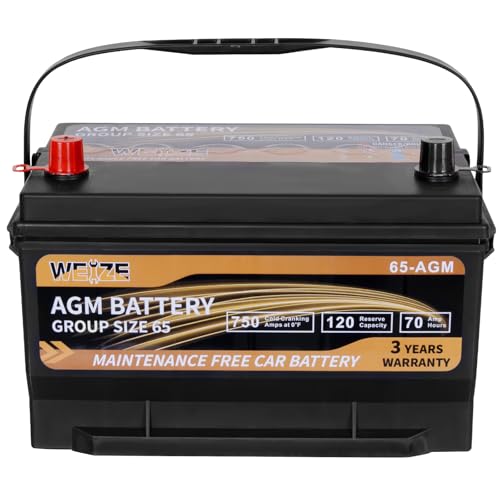
3. Weize Platinum AGM Group 65 — strong reserve, mainstream specification
- Best for: owners who want a full AGM pair with strong capacity and reserve figures, and who will verify dimensions and terminal layout before ordering.
owners who want a full AGM pair with strong capacity and reserve figures, and who will verify dimensions and terminal layout before ordering.
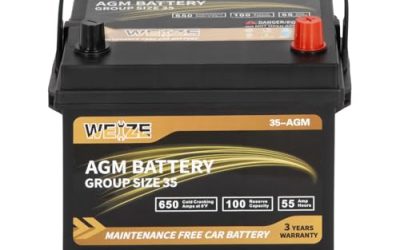
The Weize Platinum AGM Group 65 is listed at 12 volts, 70 amp-hours, 750 CCA and 120 minutes of reserve capacity, with dimensions of about 12.05 by 7.56 by 7.56 inches and a 36-month warranty described in the listing. Its terminal layout is listed as tapered terminals with positive on the left and negative on the right. That combination is a sensible mainstream diesel specification: the capacity and reserve figures are higher than the Interstate MTX below on capacity, and equal on reserve, while the cranking rating matches it.
For a 6.9L IDI that starts reasonably well in mild weather, a matched pair of these batteries provides a lot of total stored energy. The 120-minute reserve figure is worth noting for trucks that sit between jobs or that run lights, a radio and other loads with the engine off. AGM construction also helps a truck that is parked for periods, because AGM batteries generally self-discharge more slowly than conventional flooded batteries, although no battery should be left discharged, and a truck stored for months still benefits from a suitable maintainer.
The caution is the same one that applies to every value-oriented listing: read the current listing carefully, confirm the group, the dimensions and the terminal side, and check the warranty process before you need it. Fitment tools on a listing are a guide, not a guarantee for a truck that is several decades old and may have non-standard trays or cables.
4. Interstate Batteries MTX Group 65 — AGM pick for long service life
- Best for: owners who prefer an established national brand, want a slightly lighter Group 65 AGM to install, and are replacing both batteries together.
owners who prefer an established national brand, want a slightly lighter Group 65 AGM to install, and are replacing both batteries together.
The Interstate MTX Group 65, model MTX-65, is listed as a 12-volt, 68 amp-hour AGM battery rated at 750 CCA. Interstate describes its MTX design as packing more lead into the battery and positions the line for long life in start-stop and demanding vehicle use. The battery is spill-proof by virtue of its absorbed glass-mat construction and is listed at about 45 pounds, which makes it the lightest individual battery in this comparison — a small but real advantage when you are lifting two of them into a high truck engine bay.
Do not read the start-stop positioning as a reason to reject it for an older diesel. What matters for the 6.9L IDI is the group size, the cranking rating, the capacity and the construction, and on those points the MTX-65 is a legitimate Group 65 AGM starting battery. Its 750 CCA rating matches the Weize, and its capacity is close behind. Where it may appeal most is to an owner who values the support network and warranty handling associated with an established battery brand available through local dealers as well as online listings.
Confirm the reserve capacity on the current listing before you compare it directly on that number, and again, buy and fit these as a matched pair. If one of your current batteries has failed early, test the charging system as well. An alternator or voltage regulator problem that undercharges or overcharges will shorten the life of any new pair, whatever the brand.
How to choose between these four
Start with your climate and your starting history. If the truck barely turns over on cold mornings, or it lives where winter temperatures stay low for weeks, prioritise cranking rating and choose between the Odyssey and the Interstate MTZ. If the truck starts acceptably but sits for periods or runs accessories, reserve capacity and capacity deserve more weight, which strengthens the case for the Weize and its 120-minute reserve rating. If ease of installation and brand support matter most, the lighter Interstate MTX is worth a close look.
Next, be honest about the rest of the starting system. Batteries are the most common cause of a slow diesel crank, but they are not the only cause. A worn starter, a poor ground strap between engine and chassis, corroded cable ends, and a glow plug system with several dead plugs can all imitate a weak battery. If you fit a new pair and the crank is still slow, do not simply buy a bigger battery. Have the starter draw, the cable voltage drop and the glow plug system checked. Throwing capacity at a fault wastes money and can mask a problem that will eventually leave you stranded.
Fitting a pair safely
Replacing two large batteries is straightforward but unforgiving of shortcuts. Switch everything off, note which cables go where, and photograph both trays before you disconnect anything. Remove the negative cables first and refit them last, keep metal tools away from both terminals at once, and lift with help. These batteries weigh roughly 45 to 54 pounds each in this comparison, and an engine bay forces an awkward lifting posture.
Clean the trays, repair or replace damaged hold-downs, and clean the cable ends until the contact metal is bright. Fit both new batteries, secure them so they cannot move, and connect the cables firmly. A battery that can shift in its tray will suffer vibration damage and can chafe cables. After fitting, start the truck and check the charging voltage, then recheck terminal tightness after the first few drives.
Dispose of the old batteries through the seller’s core process or a local recycler. Lead-acid batteries are highly recyclable, and the core system exists for exactly this exchange. Do not store old batteries where children or animals can reach them, and wash your hands after handling corroded terminals.
Common mistakes with 6.9L IDI batteries
The most common mistake is replacing only one battery. The second most common is mixing types — one AGM and one flooded battery, or one new battery and one old battery of the same type. Both mistakes create an unbalanced pair in which the batteries charge and discharge unevenly. The third mistake is buying on CCA alone and ignoring the group size, then discovering that the case, the hold-down or the terminal layout does not match the truck. The fourth is ignoring the cables. On a truck of this age, the cables and grounds are consumable parts in practice, and they deserve inspection every time the batteries are changed.
Frequently asked questions
Do I really need two batteries for a 6.9L IDI?
In factory form, yes. The truck was designed around a parallel pair to deliver the cranking current a high-compression diesel with glow plugs requires. Running on one battery, or on a mismatched pair, makes cold starting harder and shortens battery life.
Can I use a single larger battery instead of a pair?
Not as a simple substitute. The trays, cables and hold-downs are arranged for two Group 65 batteries. A conversion would need proper engineering of mounting, cabling and protection, and it is outside what this guide recommends.
Should both batteries be exactly the same model?
Ideally, yes. Same model, same type and bought and fitted at the same time is the safest approach for a parallel pair. At minimum they should be the same group, the same construction type and a similar age and capacity.
Is AGM better than flooded for this truck?
AGM offers sealed, maintenance-free construction, good vibration resistance and strong cranking performance, which suits many owners. A quality flooded battery in the correct group can also start the truck. What matters most is correct size, adequate cranking rating, a matched pair and a healthy charging system.
How long should a pair last?
Service life varies widely with climate, charging condition, depth of discharge and how often the truck sits unused. Heat, chronic undercharging and sitting discharged shorten life more than age alone. No specific lifespan is promised for any pick in this guide.
Bottom line
For a Ford 6.9L IDI, buy Group 65 starting batteries as a matched pair and choose on cranking headroom first if your winters are cold. The Odyssey ODX-AGM65 offers the strongest published specification here, the Interstate MTZ is a high-rated pure-lead alternative, the Weize Platinum pairs a 750 CCA rating with strong capacity and reserve figures, and the Interstate MTX offers a slightly lighter, established-brand AGM option. Whichever pair you choose, fix corroded cables, broken hold-downs and charging faults at the same time, or the new batteries will inherit the old problem.