Our Short List of 3

- Best for: patient glassing of open country where deer appear far off and light is fading.
- Magnification: 20-60x
- Objective lens diameter: 85 mm
- Optical system: HD, fully multi-coated lenses
- Field of view: 108-60 ft at 1,000 yards
- Best for: mobile hunters who need an 80mm picture without an 80mm carry penalty.
- Magnification: 20-60x
- Objective lens diameter: 80 mm
- Lens coating: fully multi-coated
- Prism: K9 with silver coating

- Best for: stand and blind hunters glassing feeding areas inside a few hundred yards.
- Magnification: 20-60x
- Objective lens diameter: 80 mm
- Prism glass: BaK-4, fully multi-coated optics
- Field of view: 105 ft at 20x, 53 ft at 60x, at 1,000 yards
All 4 Picks at a Glance
| Product | Specs | Action |
|---|---|---|
| Vortex Diamondback HD 20-60×85 Angled |
| Check price on Amazon |
| Athlon Optics Talos 20-60×80 |
| Check price on Amazon |
| Celestron Ultima 80 Angled |
| Check price on Amazon |
 Gosky Flagship DiamondEdge 20-60×80 |
| Check price on Amazon |
Key takeaways
- Four spotting scopes for deer hunting compared on objective size, zoom, field of view and carry weight, from an 85mm Vortex to a light 80mm Athlon.
A spotting scope for deer hunting is really a tool for judgment at distance. The question it answers is whether the buck across the canyon, the bean field or the cutover is legal, mature and worth a long stalk, and it has to answer in the dim first and last minutes when deer actually move. That makes objective size, glass clarity and honest carry weight matter far more than a big zoom number printed on the box.
This roundup is for ridge sitters who glass open country, stand hunters who watch field edges until dark, backpack hunters who count every ounce, and first-time buyers putting together a complete kit. The four scopes below were chosen from the names and specifications on their Amazon product pages: three 80mm models and one 85mm model, all with 20-60x zoom eyepieces.
Quick Picks
As an Amazon Associate we earn from qualifying purchases.
| Product | Best for | Key spec from title |
|---|---|---|
| Vortex Diamondback HD 20-60×85 Angled | Long sits glassing open country | 85mm objective, 20-60x zoom |
| Athlon Optics Talos 20-60×80 | Hunters who pack in on foot | 80mm objective in a composite body |
| Celestron Ultima 80 Angled | Watching field edges at dusk | 20-60×80 with BaK-4 prisms |
| Gosky Flagship DiamondEdge 20-60×80 | A complete kit in a single box | Tripod, bag and phone holder included |
How to Choose
Objective Size Decides the Last Minutes
Deer move most at dawn and dusk, and those are exactly the moments when a spotting scope earns its keep. A larger objective lens gathers more light, so an 80mm or 85mm scope holds a usable picture later into the evening than a 60mm or 65mm scope at the same magnification. Exit pupil shrinks as you zoom in, which is why judging antler points at 60x in near darkness is hard with any scope. If most of your hunting happens in the first and last half hour of light, objective size is the first number to compare.
Zoom Range and Field of View Work Together
Every scope in this roundup zooms from 20x to 60x, yet they do not show you the same picture. Field of view at 20x decides how fast you find a deer once your binoculars have spotted movement: a wide view lets you pick up the animal quickly, then zoom in to judge it. At 60x the view narrows to a fraction of that width, and heat shimmer on warm afternoons can make the top of the range unusable anyway. Treat 20x to 40x as the working range for deer hunting and 60x as a fair-weather bonus.
Weight Only Counts Once You Carry It
A spotting scope never travels alone. Add a tripod sturdy enough to hold it steady, and the real carried weight is the pair together. The lightest scope here weighs under two and a half pounds, while the heaviest passes three and three-quarter pounds before the tripod goes in the pack. For a hunter sitting a fixed stand or a truck window, that gap hardly matters. For someone climbing a ridge before daylight with a rifle, a pack and a scope, it decides whether the scope makes the trip at all or stays in the truck.
Angled Bodies and Eye Relief for Long Sits
All four scopes here use an angled eyepiece, and for deer hunting that is usually the comfortable choice. An angled body sits lower on the tripod, lets several hunters of different heights share the view without constant adjustment, and works well from a seated or prone position behind a ridge. Eye relief matters if you wear glasses: look for a figure near 18mm or more at low power so you can hold the full picture without pressing your lenses against the eyecup. Long glassing sessions punish poor ergonomics long before they punish modest glass.
The 4 Best Options
Vortex Diamondback HD 20-60×85 Angled
- Best for: patient glassing of open country where deer appear far off and light is fading.
- Magnification: 20-60x
- Objective lens diameter: 85 mm
- Optical system: HD, fully multi-coated lenses
- Field of view: 108-60 ft at 1,000 yards
patient glassing of open country where deer appear far off and light is fading.
at 60.9 oz before the tripod, this is the heaviest scope here; confirm your tripod head is firm enough to hold it steady at 60x.
The Diamondback HD is the scope for a hunter whose deer season is spent behind glass: seated on a ridge, a powerline cut or a big field edge, picking apart cover for hours. Its 85mm objective is the largest in this group, and the HD optical system with fully multi-coated lenses is built to hold contrast when a buck steps out in flat evening light. The Arca-Swiss compatible foot mounts directly to a quality tripod head, and argon purging with O-ring seals keeps the view clear when cold mornings follow warm afternoons.
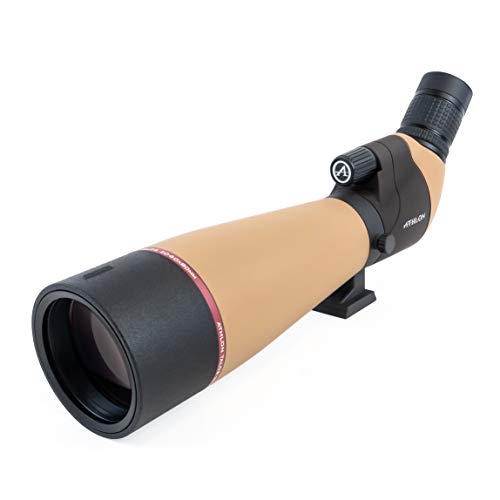
Athlon Optics Talos 20-60×80
- Best for: mobile hunters who need an 80mm picture without an 80mm carry penalty.
- Magnification: 20-60x
- Objective lens diameter: 80 mm
- Lens coating: fully multi-coated
- Prism: K9 with silver coating
mobile hunters who need an 80mm picture without an 80mm carry penalty.
the included table-top tripod is a low, seated-height support; hunters who glass standing will want a taller tripod of their own.
The Talos suits the hunter who walks in: public-land walkers, saddle hunters and anyone whose spotting scope competes with a rifle, water and layers for pack space. The composite chassis keeps this 80mm scope down to a weight closer to many 65mm models, yet the objective still gathers the light needed for early and late judging. Fully multi-coated lenses and silver-coated K9 prisms do the optical work, and the box includes a table-top tripod and a soft case, so it can ride in a pack and serve on a window ledge or a low tripod the day it arrives.
Celestron Ultima 80 Angled
- Best for: stand and blind hunters glassing feeding areas inside a few hundred yards.
- Magnification: 20-60x
- Objective lens diameter: 80 mm
- Prism glass: BaK-4, fully multi-coated optics
- Field of view: 105 ft at 20x, 53 ft at 60x, at 1,000 yards
stand and blind hunters glassing feeding areas inside a few hundred yards.
eye relief is quoted at 20x and tightens as you zoom; glasses wearers should plan to judge deer at moderate power rather than at 60x.
The Ultima 80 is the steady, long-running design in this group, and it fits hunters who watch known ground: a food plot, a field edge, an orchard corner where deer feed in the open at last light. Its BaK-4 prisms and fully multi-coated optics give a bright 20x picture with the widest low-power field of view among the 80mm scopes here, which makes it quick to get on a deer that steps out between trees. The body is waterproof and nitrogen filled, a padded soft case comes in the box, and the eyepiece accepts a camera adapter for hunters who like to film what they find.
Gosky Flagship DiamondEdge 20-60×80
- Best for: new deer hunters who want a working glassing kit without buying pieces one by one.
- Magnification: 20-60x
- Objective lens diameter: 80 mm, fully multi-coated
- Prism: BaK4
- Field of view: 82.9-48 ft at 1,000 yards
new deer hunters who want a working glassing kit without buying pieces one by one.
the bundled tripod is a light tabletop-style support; on windy ridges or at full zoom it is the first part of the kit most owners replace.
The Gosky Flagship is aimed at the first-time buyer who wants one box to end the shopping: scope, tripod, carrying bag and a phone holder all arrive together. That makes it a sensible pick for a young hunter’s first season, a camp scope shared between stands, or a spare optic kept in the truck. The 80mm fully multi-coated objective and BaK4 prism cover the same 20-60x ground as the rest of this group, the body is nitrogen filled and waterproof, and the phone holder lets a hunter record a buck for a second opinion before deciding on a stalk.
Which One Fits Your Situation
Sitting a Ridge Over Open Country
When the job is scanning basins and picking apart shaded pockets a mile out, the Vortex Diamondback HD earns its weight. The 85mm objective and wide 108 ft field of view at 20x help you find deer and then judge them, and the sealed, argon-purged body shrugs off the weather swings that come with exposed high ground.
Watching a Field Edge Until Dark
For a stand overlooking a plot or a field corner, the Celestron Ultima 80 is the natural fit. Its wide, bright 20x picture covers a feeding area without constant panning, the 80mm objective stays useful into the last legal minutes, and the angled body is comfortable for the seated viewing that stand hunting mostly involves.
Walking In Several Miles Before Dawn
If the scope has to earn its place in the pack every single morning, take the Athlon Talos. It keeps an 80mm objective at a carry weight many hunters associate with much smaller glass, and the included case and table-top tripod cover low, seated glassing from a ridgetop or a clearing edge without extra purchases.
Buying a First Scope for Stand Hunting
A first scope should remove excuses to leave it behind, and the Gosky Flagship kit does that by arriving complete. Scope, tripod, bag and phone holder come together, so a new hunter can glass a field edge the same weekend, film a borderline buck, and learn what good judging distance feels like before upgrading any single piece.
Common Mistakes
- Buying on maximum zoom alone, then finding that 60x is dim, narrow and shaky in real field conditions.
- Pairing a full-size scope with a flimsy tripod, so the view trembles too much to judge antler points at any power.
- Ignoring eye relief and discovering, with glasses on, that half the picture is cut off at the settings used most.
- Leaving the scope in the truck because the combined weight of scope and tripod was never honestly weighed at home.
- Glassing only at high power and missing deer that a wide 20x sweep of the same hillside would have shown at once.
Frequently Asked Questions
How much magnification do deer hunters actually use?
Most judging happens between 20x and 40x. Low power gives the wide, bright view needed to find deer and follow movement, while the middle of the range resolves antler points and body size at typical glassing distances. The 60x end helps on calm, clear mornings at long range, but heat shimmer and dim light often make it the least used setting on the dial.
Is an 80mm objective worth the weight over a 65mm scope?
For deer hunting, usually yes. The bigger objective gathers more light, which is what the first and last minutes of the day demand, and it keeps the picture brighter as magnification climbs. A 65mm scope is easier to carry, so the honest trade is distance walked against minutes of usable light. Hunters near their stand can carry the 80mm; deep-country walkers may accept the smaller glass.
Angled or straight body for hunting from a blind?
Angled, for most blind and stand setups. The eyepiece sits lower, so the tripod can stay shorter and steadier, and hunters of different heights can share the scope by swiveling the body rather than rebuilding the setup. Straight bodies aim more naturally at a deer spotted below you, which is why some mountain hunters prefer them, but for seated watching the angled design is easier to live with.
Can a spotting scope replace binoculars for deer hunting?
No, and it should not try. Binoculars are for finding deer: wide, fast and usable with cold hands. A spotting scope is for judging the deer you already found, at distances where binoculars cannot separate a legal buck from a young one. Hunters who carry only a scope spend their mornings panning a narrow view and miss animals that a quick binocular sweep would have caught.